


Welcome to Payments Culture!

This newsletter explores how money moves, across borders and cultures, and how it’s changing.
Any comments or feedback about this post are welcome. Leave a comment at the bottom of this post or you can reach me directly via LinkedIn, Twitter (X), or email.

“Speed, transparency and cost” are the three things finance teams most often struggle with when moving money, Patrick Mollard told me when we spoke earlier this month. Patrick is one of the co-founders of Fipto, a Paris-based stablecoin payments infrastructure company, working mainly with PSPs and corporate treasury teams.
Patrick previously spent almost seven years at iBanFirst, a provider of cross-border payments solutions for small and medium-sized businesses, working first as CFO and then later as the company’s COO. During his time at iBanFirst, the company grew from fewer than ten people to around 300 across 10 European countries. Getting to see what worked well — and what didn’t — when firms move money and manage their financial operations day-to-day was valuable, and the experience helped lay the groundwork for what came next. When a US private equity firm took a majority stake in iBanFirst in July 2021, Patrick and his co-founders decided to build something new.
“The way things operated hadn’t changed for a long time. The same technology has been in place, more or less, since the 1970s. We thought there was probably something we could bring to the table to improve it.”
Patrick started Fipto in 2022 with co-founders Grégoire Andrieu-Guitrancourt and Bertrand Godin, who held senior roles at iBanFirst as CRO and Head of Operations respectively. Fipto was a chance to build a company utilising blockchains and stablecoins to make moving money faster, cheaper and more efficient.
As founders, Fipto’s executive team has deep expertise in what we could call traditional payment rails and infrastructure. This differs from many companies with crypto-native founders. They may have experienced the challenges of legacy payment systems, and of sending money themselves, but rarely have crypto founders spent years at the coalface: building, solving problems and getting into the weeds of correspondent banking, FX and settlement issues.

This gives Fipto a different perspective, and with this experience comes the realisation that existing payment technology won’t be replaced wholesale any time soon. As Patrick makes clear: “Swift is working well on certain corridors and in certain use cases. What we try to do is offer an alternative when it can be done better or in a different way.” Some companies benefit from the 24/7 settlement that stablecoins offer, which helps their operational processes and liquidity. As an example, Patrick points to TerraPay, one of Fipto’s larger clients:
“They don’t have to have cash sitting with their payout partners everywhere in the world. They just pay them exactly what they need, at the time they need it. That reduces their working capital needs quite significantly.”
One other area where stablecoins can deliver benefits, but an area which is often underreported and underdiscussed, is correspondent banking.
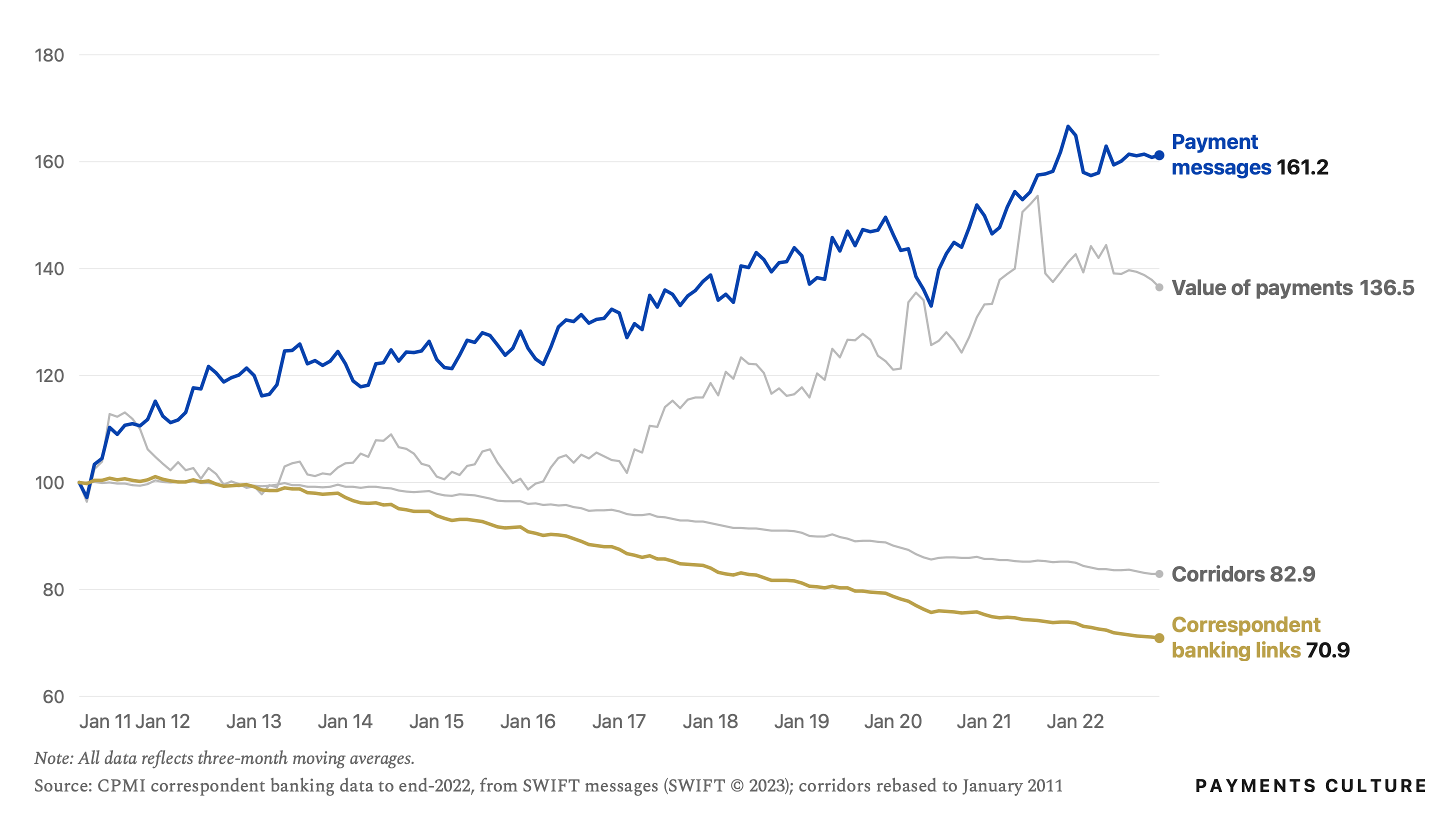
A correspondent bank holds accounts for other banks and makes payments on their behalf particularly where the bank may have no direct presence. This can be in terms of both geography and currency. If a bank in South America wants to pay a supplier in Europe, the money usually passes through one or more correspondent banks along the way. Yet despite the necessity of correspondent banks, the number has fallen significantly since 2011, partly due to an increase in regulations following the Global Financial Crisis of the late 2000s.
Banks and other financial institutions have had to step up their efforts to comply with the standards and regulations. Faced with higher regulatory expectations, banks may choose to scale up or stop providing correspondent services, concentrating the business in larger global transaction banks.
- BIS Quarterly Review, On the global retreat of correspondent banks (March 2020)
For some banks, the cost of operating certain payment corridors stopped making sense. This was due to additional money laundering and terrorist financing rules that brought additional compliance costs, and thin volumes on some payment corridors meant insufficient revenue to cover business overheads.
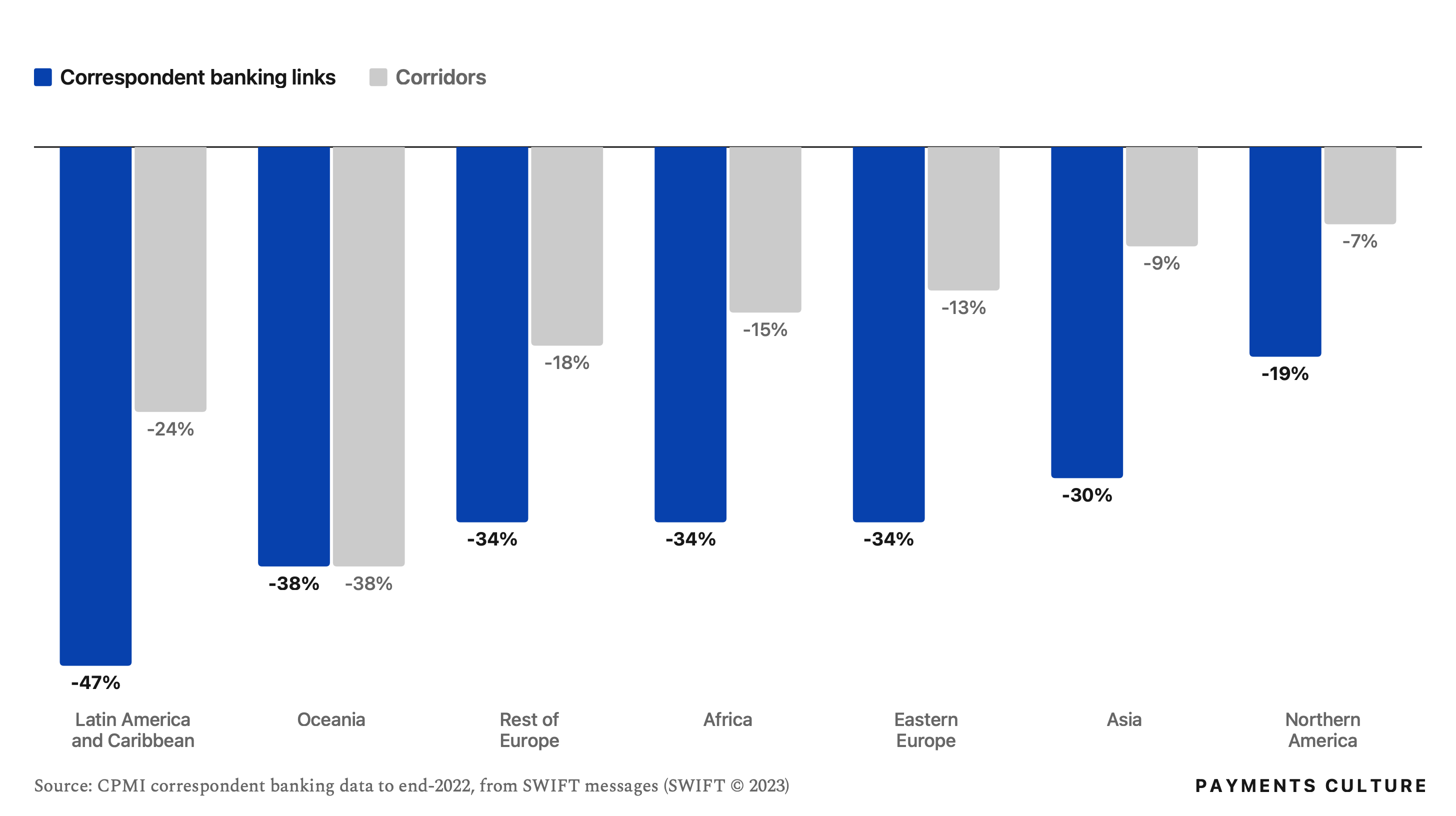
Stablecoins can help here, as onchain payments move between sender and receiver without a chain of intermediaries. In regions where correspondent banking is relatively weak, payments with Swift can struggle — Patrick sees this as exactly where stablecoins can make a difference. Where correspondent banking has thinned out it’s become harder to pay into some markets.
Earlier this year when launching a EUR-BRL payment corridor with São Paulo-based cross-border payments firm Avenia, Fipto noted “by using stablecoins as the settlement layer, we remove the need for correspondent banks.” The partnership allows for 24/7 payment flows in each direction. This is notable, as the BIS previously stated that Latin America was the region hardest hit by the pullback of correspondent banks.
Fipto has raised around €20 million to date and runs with a team of 23. Much of the early investment went into licensing. The company holds a payment institution licence in France and, since the start of this year, a full MiCA CASP licence. Gaining such licences takes time and effort but it’s worthwhile as it helps earn trust, and when dealing with large payment service providers, the correct licences and authorisations are not nice-to-haves but table stakes.
In terms of regulation, while the CLARITY Act has not yet passed in the US, the EU’s MiCA regulation changed the conversation. Some stablecoin initiatives have advanced since MiCA, which has applied in full since December 2024. The regulatory certainty gave some companies the confidence to proceed with their stablecoin initiatives. Banks are now considering launching their own stablecoins, as Revolut recently did, or joining initiatives such as Qivalis, which is backed by 37 European banks including ING and BNP Paribas.
For Fipto, a recently announced partnership with Spiko, the Paris-based issuer of tokenised money market funds, lets clients put stablecoin balances into Spiko’s UCITS funds directly from the Fipto platform. UCITS is the EU’s framework for regulated investment funds. Customers get a return on their EURC and USDC balances without first off-ramping to a fiat bank account. “Looking at DeFi solutions is not at all something they [large corporates] are considering for now. It’s really [more about] money market funds and safe investments,” Patrick told me.
This reflects how finance teams are willing to operate onchain without chasing the high yields often associated with crypto products (we’ve seen companies like Celsius and BlockFi draw in consumers with high-interest accounts, but both went bust in 2022 and consumers lost money). Treasurers are keeping the same risk appetite. In a similar vein, many finance teams hold balances in multiple currencies, and more are now willing to keep a portion of their USD balance onchain, for instance as USDC stablecoins.
“Fast stablecoin payment rails combined with yield on idle cash are what the finance of tomorrow looks like to us.” — Patrick Mollard, announcing the Spiko partnership
On the horizon, one thing to watch is the growth of euro stablecoins. Patrick sees real demand from European corporates for euro stablecoins, both as a means to avoid FX exposure, and also as a way to work with local counterparties such as Société Générale with its EURCV stablecoin.
While institutional interest is growing, circulation is small compared with dollar stablecoins. Overall, the euro stablecoin market is still tiny, at less than 0.5% of the size of the dollar equivalent. For now, the dollar dominates. As euro stablecoins build liquidity, Fipto is on hand to help make them a success.
Links, news, and views
Taking a look at other stories that caught my eye
Last week was a difficult one for Revolut. Its app and services including card payments, bank transfers, and cash withdrawals were disrupted for most of the day on Tuesday 20th October. The outage was caused by an issue with the Google Cloud data centre europe-west2-b zone. Customer impacts were felt most heavily in the UK and Ireland but issues were reported as far away as Singapore. The issue at the Google Cloud data centre was resolved in the early afternoon UK time, yet it took Revolut well into the evening to get most services back up and running.

On the one hand some may argue users cannot expect apps to work perfectly all the time, and some outages are to be expected especially when the fault lies with a third-party cloud provider. Yet on the other hand, the UK financial regulator, the FCA, is clear that “firms remain responsible for their own operational resilience, including any services that they outsource to third parties.”
Other affected companies got their services back online and functioning much earlier than Revolut did. (I’ve heard that some smaller organisations got back online within 20 minutes.) Also Revolut should have plans in place to move to operate via another Google Cloud data centre should it suffer an outage, and Monzo has in place a second cloud provider so rather than just switch data centre location, in the course of an outage they can utilise another provider entirely — switching back when the time is right.
Not being able to access money for much of a day may lead some customers to reassess risk. In some cases, where companies and individuals keep their cash may come down to uptime as much as interest rates or the user interface. No one wants to be in a situation where they can’t access their cash. The one positive, and speaking as a Revolut customer, is that I’m sure the bank will be reviewing its resilience and cloud setup after this. Hopefully improvements mean we won’t see such an outage again.
Nubank is the closest comparator we have with Revolut. According to the latest publicly available data, the bank has 140 million customers across three Latin American countries (Mexico, Colombia and Brazil), with 118 million of its customers based in its home market of Brazil. It also launched in the US last month under the Nu brand. In comparison, Revolut has more than 80 million customers spread across more than 40 markets.
In the podcast linked above we learn a lot about Nubank. Founder David Vélez explains that 90% of global banking still runs through branches and via legacy banks. Vélez states that Nubank’s cost base is 3% of the incumbents in Brazil; yet this was prior to AI, in other words, it can still be optimised further. He mentions that the low cost base means the bank has “so much margin to give back to the customer.” This got me thinking. Fintech emerged as a means of providing financial services at a lower cost, with better technology, and predominantly via mobile apps. Consumer financial services is a $10 trillion industry (Vélez’s figure), so fintech is far from dead. There’s still so much to do.
Thanks for reading!
Have a great week and feel free to reach out with any comments or feedback.
Please consider sharing this newsletter with a friend or colleague if you enjoyed reading this edition. If you are not yet a subscriber please sign up below for a free or paid subscription.
Note that views expressed on this Substack are my own and do not represent any other organisation. Also nothing I say should be taken as investment advice.