


This April I spent two nights in Seoul. I’d spent the previous two weeks in Taiwan and the two and a half weeks before that in New Zealand. After more than a month away from home it was time to head back to London, but before flying back I had a day free in Seoul.
I went to the new Hyundai shopping mall in the Yeouido district. I’d read that the food court was worth a visit and it didn’t disappoint. Located on the basement floor of the shopping centre, Tasty Seoul (as the food court is known) features something for everyone: bakeries; a variety of Korean food; and of course you can get a burger if you want — there’s a local burger restaurant and even a Five Guys, which has exactly the same menu as Five Guys in London.
After my lunch I went to the grocery store to get some snacks and a drink. When I went to pay I saw this.
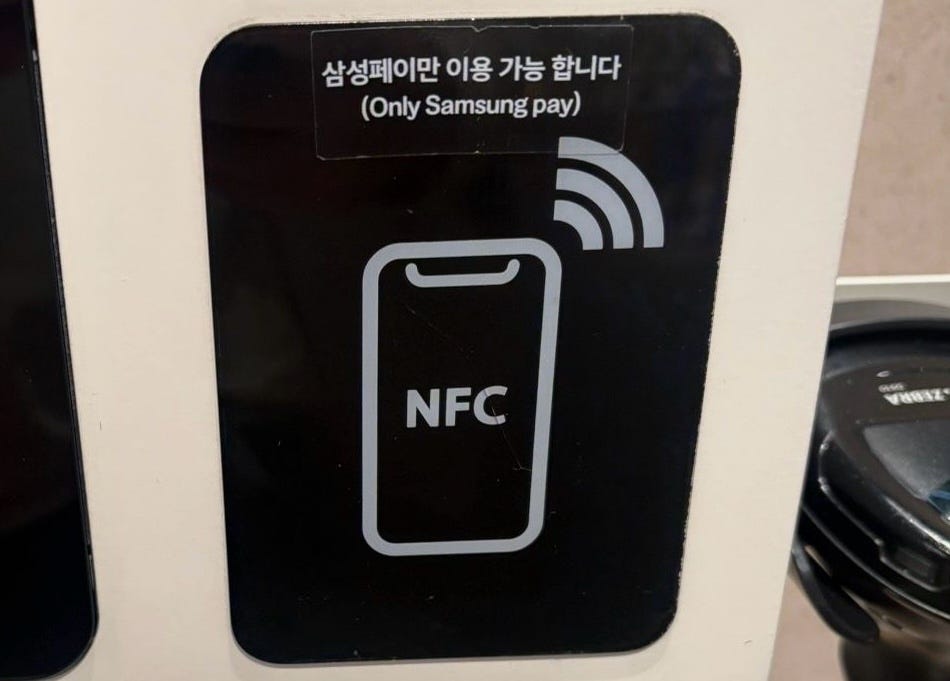
Only Samsung Pay could be used to pay. I’d never seen something like this before. Usually if a store allows for NFC (contactless payments) this means Apple Pay, Google Pay, Samsung Pay, and physical contactless cards can be used. In the UK all of these payment options work on our card payment infrastructure but payment infrastructure in South Korea evolved differently. Enabling Apple Pay may require stores to update their payment hardware or use a different payment protocol from what has been the norm in South Korea. Apple Pay only entered the South Korean market in 2023 (it launched in the US in 2014, and the UK in 2015), and given the high share of non-Apple devices, merchant demand to offer Apple Pay as a payment option at the point of sale is much less than in most other Western economies.
Merchant demand for Apple Pay is also impacted by consumer demand and distribution. Merchants don’t want to go through the effort and cost of updating their protocols and hardware to support Apple Pay if few people will use it. Until this week only one card issuer, Hyundai Card, offered Apple Pay. Now KakaoBank also offers Apple’s mobile wallet. Other issuers are concerned by the fact that Samsung Pay is free whereas Apple Pay incurs fees for every transaction.
The current dominance of Samsung devices in the market is striking. Samsung Galaxy devices are used by 81 percent of South Korean smartphone owners. The company is of huge importance to the South Korean economy overall. When the markets closed at the end of last week Samsung was valued at around $1 trillion (₩1,324 trillion), making it one of the world’s 15 largest publicly traded companies. The company’s share price has doubled in the past year driven mainly by the demand for AI memory chips, and Samsung alone makes up around 25% of the South Korean stock market, known as the KOSPI.
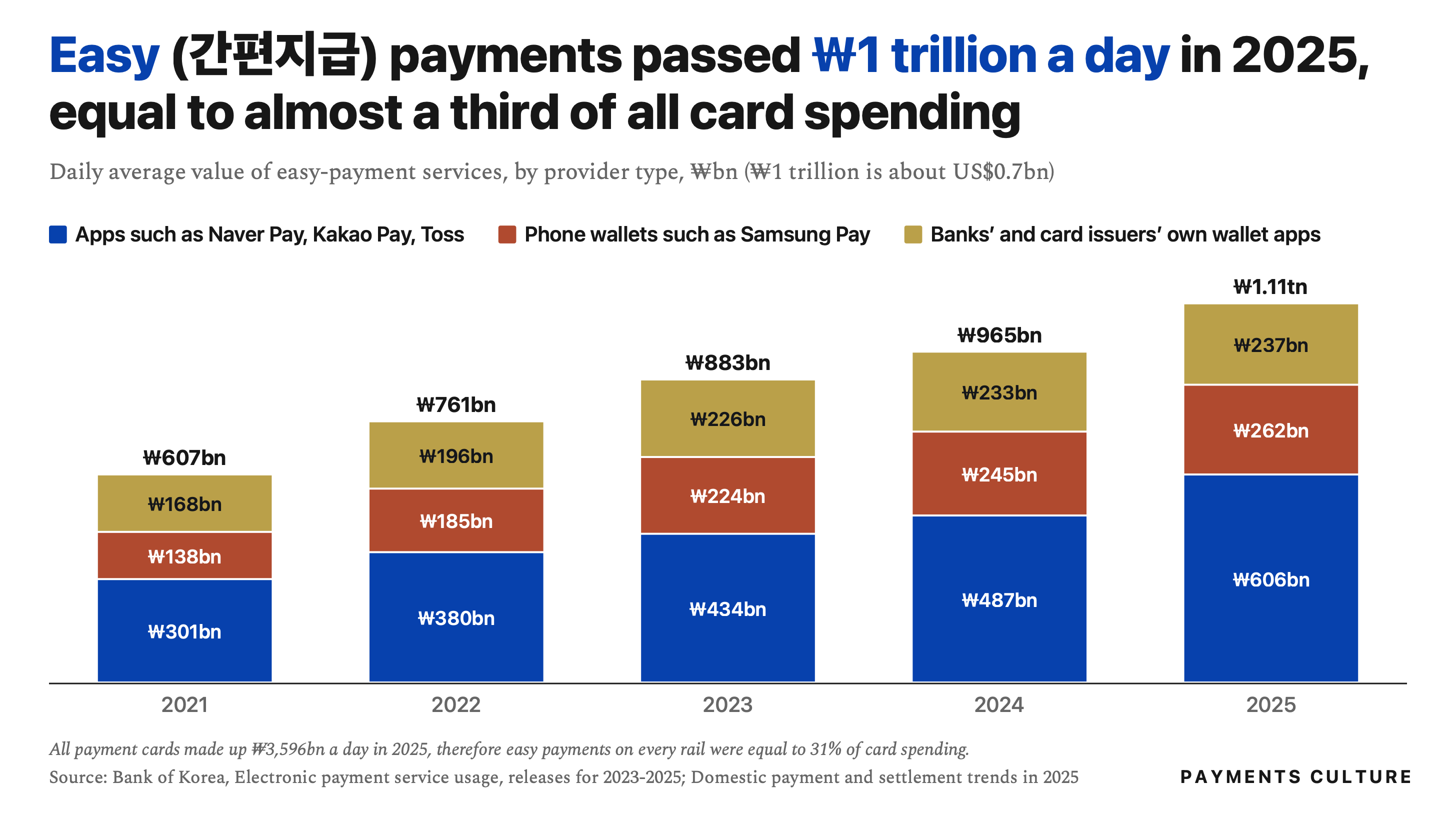
One notable trend in South Korea has been the rise of what the Bank of Korea calls easy payment services, 간편지급 in Korean (also known as 간편결제). These are payments made through the domestic consumer app ecosystem, and mobile wallets such as Samsung Pay and Apple Pay. Additionally as the mobile payment ecosystem evolved early in South Korea, some card issuers still have their own apps that store card payment credentials. Examples of this include KB Pay and Shinhan SOL Pay, which together have more than 18m monthly users. Together easy payment services have grown to make up almost a third of total card payments in the market — up from less than a fifth in 2020.
The growing blue section on the chart above provides an insight into the success of South Korea’s app ecosystem. There are no super apps in a traditional sense. No direct equivalent of China’s WeChat, an app that allows you to do almost anything. Instead South Korea has families of apps under one brand, with one login and a shared wallet. The main examples are Kakao and Naver. Meanwhile Toss is the closest thing in the market to a financial super app. It can be used to hold investments, to transfer money between accounts, pay in store, and its online payment is comparable to PayPal in the UK or US.

Payments Culture is a newsletter about how money moves, around the world, and how it’s changing.
It comes with:
Expert perspective from my 15+ years working in the industry
Real-world stories that go beyond the headlines
Market intelligence you won’t find in press releases

What some of my readers have said about this newsletter:
Matt brings theory to life by using his personal experiences to explain the world of payments.
For what it’s worth, your newsletter is the only one I read regularly. Love your storytelling!
Your detailed yet high-level style is a writing gift not everybody has.
Readers of this newsletter work for organisations such as:
Visa, Mastercard, JPMorgan, Stripe, Adyen, American Express, Checkout.com, Block, Revolut, Wise, Robinhood, Plaid, Affirm, Airwallex, Barclays, Andreessen Horowitz, General Atlantic, Tiger Global.
If you’d like to support this newsletter you can upgrade to a paid subscription.
You can contact me on LinkedIn, Twitter (X), via email, and with the below button.
There’s no Samsung in North Korea, and unlike its neighbour, whose cultural exports are well known throughout the world (K-Pop, K-Beauty, K-Drama), North Korea is not well known for much at all, at least not in terms of pop culture. It’s a closed-off society. A place where even Chinese citizens are, with few exceptions, banned from visiting. But the one thing the country is increasingly known for is hacking. According to the FBI, the recent $6bn hack of cryptocurrency exchange Binance was the work of the DPRK (the Democratic People's Republic of Korea) as North Korea is formally known. Generally speaking if a country has the word democratic in its official name then it likely isn’t very democratic — East Germany being a prime historical example of this.
Hacking as a strategy
This may sound strange to say, but North Korea has deliberately developed a comparative advantage in hacking. A report by Alex O’Neill for the think tank RUSI highlighted that North Korea is by far the largest practitioner of cyber-criminal statecraft in the world. Sanctioned and locked out of much of the normal global economy, North Korea has a talent pool of hackers that are state directed. They operate with military as well as commercial objectives and are a major tool of state influence that allows the country to clandestinely project power beyond its borders.
Reuters recently reported that children as young as 11 are picked out and trained over many years before joining the country’s elite hacking fraternity. Taking billions out of an exchange like Binance is no mean feat and with an estimated workforce of 6,000-8,000, the revenue haul per employee for North Korean hackers is right up there with some of the most efficient companies in the world.

Korea was separated in 1945, with the two states that we commonly call North and South Korea founded in the years that followed. The Korean War (1950-1953) ended in an armistice that put in place today’s border. Families were split, usually for good, with almost no prospect of meeting again if they had loved ones on the other side of the Demilitarised Zone (DMZ), which separates the two Koreas. Over time the North and the South developed quite differently — both materially and ideologically.
Yet Koreans on both sides share a language, history, and in many cases family ties (although sadly these may have withered due to the long passage of time). Reunification of the Koreas feels as far away as ever, but still this is a story of one people, living in two states, side by side yet worlds apart.
I started thinking about how money works in North Korea. South Korea is a modern society with a financial system to match but how does money work in the North? Do people pay with cash? Or something else? It could even be a barter economy… After reading about the Binance hack I wanted to learn more.
Remittances are everywhere
Remittances are one of the use cases for which fintech is well known. People all over the world send money to family members back home, and increasingly this is done via mobile apps. Companies like Western Union are well known for facilitating remittances, and recently stablecoins have played an increasing role in allowing users to send money quickly and cheaply across borders and continents. Getting money from South to North Korea is difficult. But it happens. Mainly remittances come from defectors sending money back to their family still living in the North.
Here’s how it works:
In South Korea, a broker is paid in cash, or money is wired to a Chinese bank account that the broker controls. Unlicensed money transfer is illegal in China, so brokers may use bank accounts in other people’s names so they are not linked to the transfers.
The broker’s business partner in China rings a contact on the North Korean side, who answers using a smuggled Chinese phone. Calls are made from hilly border areas at night in order to catch a signal from China and to avoid North Korean detection.
On the North Korean side, working clandestinely is a must, but border guards and officials may be bribed by the local broker if and when needed. Part of the reason for the bribes is to protect the receiving family, as if they get caught receiving money the result could be prison.
Interestingly, actual cash rarely crosses the border. The family is paid from cash the North Korean broker already holds, and settlement with the Chinese side takes place via smuggled goods from China that are sold in North Korean markets.
When a courier delivers the money, the family is filmed counting it, which works as a receipt for the original sender. The recipients get around 60% of the original transfer (see below table), because the many parties involved all take a cut.
Here it’s important to say that sending money to North Korean banks is illegal under UN, EU, US and UK sanctions. South Korean nationals cannot send money to the North without government approval as doing so breaches the national Foreign Exchange Transactions Act. Several recent court cases against those who have sent money to family in the North have found in favour of the defendant, but there are still some grey areas, and some ongoing cases.
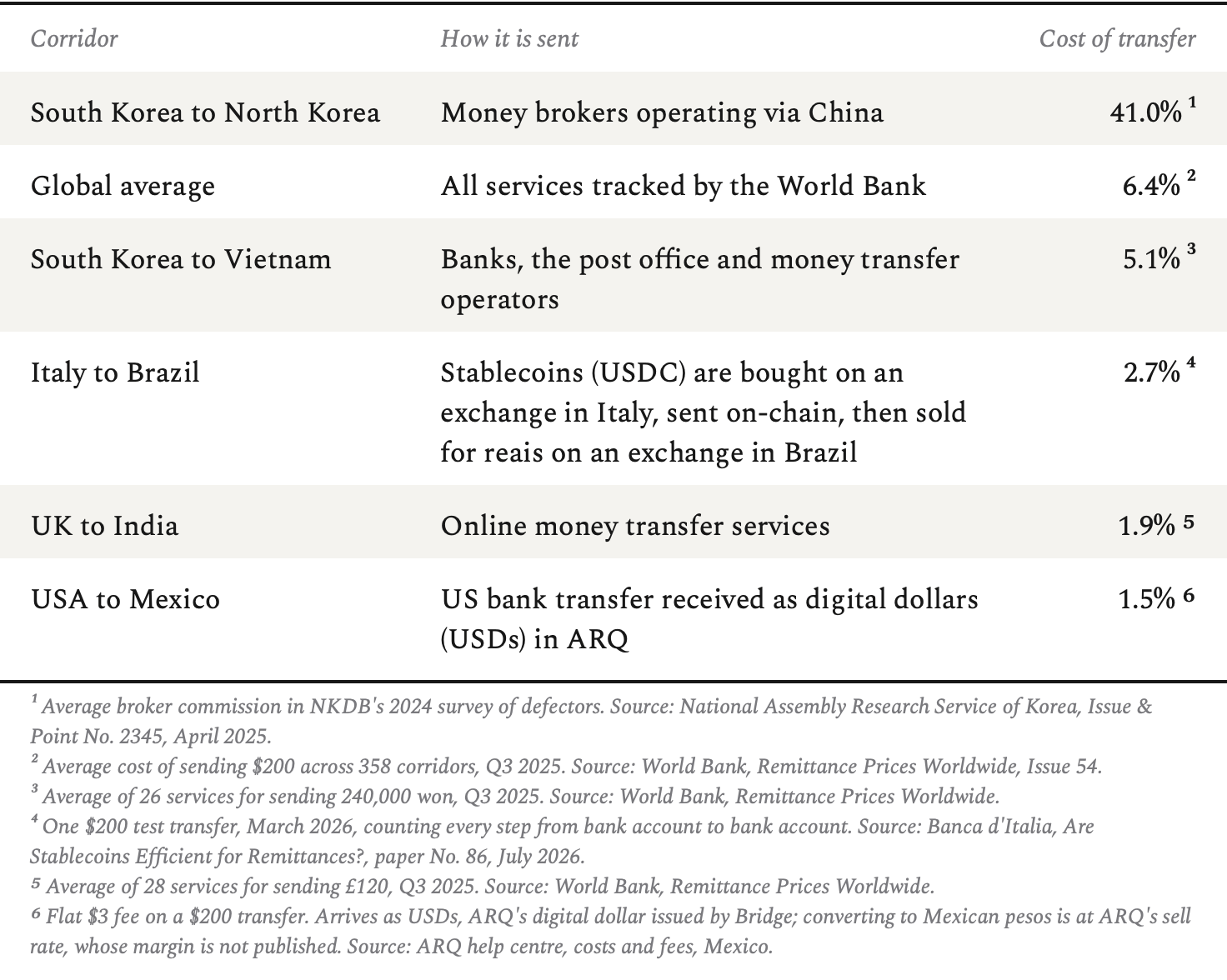
The newspaper Korea Joongang Daily tells the story of a Ms. Jung who has sent $720 to $1,450 each year to her family in North Korea since she defected to the South in 1998. Such remittances are the only way she can help her family, who presumably live in harsh conditions, and for whom receiving this money can make a huge difference. The story goes on to explain:
Despite being against the South Korean Foreign Exchange Transactions Act, the government used to tolerate these remittances... The authorities considered them a form of “humanitarian assistance” and looked the other way.
However, a police crackdown in 2023 — the first of its kind since North Korean defectors began sending money to their families in the late 1990s — pushed the defectors into a corner, cutting nearly all their connections. Indictments and criminal trials followed.
Police investigations exposed delivery routes and intermediaries. As a result, around 60 to 70 percent of connections to the North “were shattered and rendered irreparable,” according to Ju Su-yun, who assisted other defectors in sending remittances to the North. “However, money still flows into the North,” Ju said.
In reality the number of defectors who send money to family in the North is likely to be fewer than 10,000 per year. For the families that receive this money it’s a lifeline in a country where incomes are so low, however many stop sending money home after a while. Some defectors struggle to keep sending money home due to their own financial situation, and the lack of real contact with family in the North means that relationships based solely on sending money sometimes fade over time.
Mobile apps in the North
While North Korea doesn’t have Samsung, it does have Hwawon, and many other handset manufacturers. A recent report by journalist Martyn Williams, a Senior Fellow at the Stimson Center’s Korea Program and 38 North, found that there are now at least 24 competing handset brands in the market. A surprising number for such a relatively small and closed-off market. In terms of apps, more than 600 domestic apps are reportedly available across the country but these are likely to be mostly device-specific and downloaded upon purchase rather than downloaded via a central app store. Phones cannot connect to Wi-Fi networks as standard, although there have been reports of a state-run Wi-Fi network called Mirae (미래) available in Pyongyang to subscribers via a dedicated app.
In a state like North Korea the security element is key, as the report goes on to explain:
All phones run a modified version of the Android operating system with North Korean security features. Chief among these is a digital signature system that only allows content to be run on the phone if it has a digital signature from the state.
This appears to be incredibly effective in preventing North Koreans from using their smartphones for consumption of illicit content. There are other security measures too such as Trace Viewer, which takes random screenshots while the phone is being used. The screenshots cannot be deleted by the user.
Mobile devices are central to fintech in every market and North Korea is no exception. Citizens started moving money via their handsets in the late 2010s. It was quite literally a form of mobile money. Phone credit was transferred and swapped for cash. This practice was banned in 2020. What followed was an Electronic Payment Law that let non-bank companies run payment services (with Central Bank supervision). These days at least six companies make apps with payment capability via e-wallet functionality. The apps are developed mainly by IT companies rather than by banks, with Samhung being one of the better known ones.
North Korean state media claims Samhung has millions of users. Its e-wallet features payment capabilities, such as the ability to scan QR codes at merchant locations and pay directly from the app. Additionally, Samhung features “options to pay for transportation like taxis, buses, highways and the Pyongyang metro, purchase grain coupons, buy sports lottery tickets, and pay telephone and electricity bills. There are also options to reserve restaurant seats and book tours.”
So incredibly North Korea does have an app ecosystem not too dissimilar in many respects to that in the South. But missing from the local apps is the kind of chat functionality found in KakaoTalk, and we have to be mindful that it is likely the upper echelons of society that such apps are catering for. Also the app is centred mainly on the capital, Pyongyang. This is where the elite reside, and we know that as of last year, 576 of the 709 cash top-up points for Samhung e-wallets were in Pyongyang.
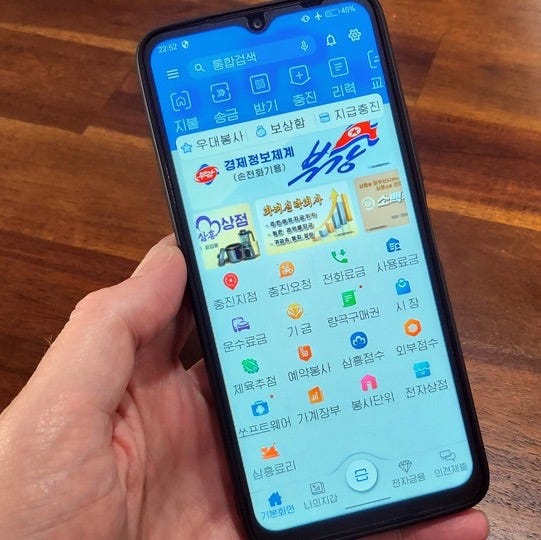
Some products for sale in North Korea are actually priced in, and must be paid for in, foreign currency, but how it works is slightly complicated. It may sound strange for such a closed economy to price in foreign currency, and it is. But since March 2025 new businesses must be able to accept payments in foreign currency in order to be granted a licence to trade. Prior to this foreign currency payments were available only at some department stores, restaurants and hotels.
North Korean citizens accumulate foreign currency cash through various means including by changing North Korean won into USD or RMB at money changers, through remittances (where the money usually arrives in USD or RMB), and through other more unofficial means.
Foreign currency payments in cash used to be acceptable but the state is now pushing more and more payments through e-wallet apps like Samhung. With this method, in order to pay in foreign currency a user must follow these steps:
Money first needs to be changed from cash into what is known as FX won, which sits within the app, and allows users to add money at a fixed exchange rate of 110 to the dollar.
Adding foreign currency incurs a 1-3% commission charge.
In-store the consumer pays with their app via QR code from their FX won balance and the state keeps the hard currency USD or RMB that the user added at the start of the process.
This is an example of how North Korea’s fintech landscape is in some ways more advanced than I expected. Yet it’s also a system that has been engineered to benefit the state. Authorities can track spending centrally and force people to pay in ways that suit the state but offer little benefit to the consumer — the FX won is a clear example of this. And it shows North Korea seeking hard currency at home, just as it does abroad when it hacks crypto exchanges such as Binance.
North Korea is a country I’m unlikely ever to see for myself. What we know about how money works in the North comes from relatively few sources: defectors, researchers, and occasionally visitors such as Russian tourists who share what they’ve seen online.
We can compare North with South to see two different models of how money works. In Seoul my only issue was not being able to use Apple Pay, but in the North many people struggle to pay for their next meal far more often than they struggle to use the right payments app. In Pyongyang those well connected and with the means can pay with a QR code in a store or a taxi yet this all happens under a model of state control rather than private competition. It’s the story of two nations, so very close… yet at the same time worlds apart.
Appendix
In the video below you can see life in the Chinese border city of Dandong. The YouTuber gets surprisingly close to North Korea itself and is able to see a variety of smuggled goods on sale in the city. Randomly watching this video just over a week ago inspired me to write this post.
Below is the full reading list from this post including all news links and other research:
Research and reports
Why Does the S&P 500 Matter to Korea? (S&P Dow Jones Indices, October 2025)
North Korea Steals USD 6.36 Billion From Binance in the Largest Hack in History (TRM Labs, October 2026)
Domestic payment and settlement trends in 2025 (Bank of Korea, in Korean, March 2026)
Electronic payment service usage in 2025 (Bank of Korea, in Korean, March 2026)
2020 Payment and Settlement Report (Bank of Korea, in Korean, April 2021)
Upholding North Korea Sanctions in the Age of Decentralised Finance (Alex O’Neill, RUSI, March 2024)
On DPRK remittances (North Korean Economy Watch, February 2012)
Smartphones of North Korea 2026 (Martyn Williams, NK TechLab, May 2026)
A Nascent Fintech Industry Appears in Pyongyang (38 North, October 2025)
The Logistics of Funding North Korean E-Wallets (38 North, July 2026)
Making Money in the State: North Korea’s Pseudo-State Enterprises in the Early 2000s (Andrei Lankov et al., Journal of East Asian Studies, 2017)
News sources
Apple Pay is now available in South Korea (TechCrunch, March 2023)
KakaoBank brings Apple Pay to millions of iPhone users in Korea (Korea JoongAng Daily, November 2026)
Shinhan, KB, Toss hesitate to adopt Apple Pay (Korea Times, October 2026)
‘Galaxy garbage?’ Samsung dominates South Korea’s smartphone market in surprise reversal (Herald Business, July 2026)
Samsung Wallet remains Korea’s top payments app (Korea Herald, July 2026)
Card spending averaged ₩3.6 trillion a day last year, with easy payments overtaking physical cards (Asia Economy, in Korean, March 2026)
North Korea’s army of world-class hackers is secret weapon that took down Binance (Reuters, November 2026)
Remittance fees increase as North Korean police demand bribes (Daily NK, April 2018)
Court overturns conviction of defector who helped send money to family in North Korea (Korea Times, July 2026)
NKDB: defectors sent $2,800 each to North Korea this year, with fees around 50% (Radio Free Asia, in Korean, December 2023)
Defectors risk legal trouble, scams to send remittances to families in North Korea (Korea JoongAng Daily, August 2025)
Donju on the losing end of recent ban on “mobile money” (Daily NK, October 2020)
North Korea touts spread of electronic payments: “millions of e-wallet subscribers” (Herald Economy, in Korean, November 2025)
N. Korea expands foreign currency payments through smartphone apps (Daily NK, April 2025)
Order to prohibit cash use in state-owned commercial facilities and enterprise transactions (ASIAPRESS, March 2026)
Average Daily Simple Payment and Remittance Surpass 2.4 Trillion Won in First Half, Setting New Record (Asia Economy, September 2026)
Thanks for reading Payments Culture. I appreciate it!
Please consider sharing this newsletter with a friend or colleague if you enjoyed reading this edition. If you are not yet subscriber please sign up below for a free or paid subscription.
Note that views expressed on this Substack are my own and do not represent any other organisation. Also nothing I say should be taken as investment advice.