


Welcome to Payments Culture!
This newsletter explores how money moves, around the world, and why it matters.
Curve has been on quite a journey. It was founded by Shachar Bialick in 2015, and last week, after much speculation, Lloyds Banking Group1 announced the acquisition of Curve. The price is reported to be £120m (approximately US $165m). But the impact of Curve goes well beyond the relatively modest acquisition price.2
The fintech had grand ambitions from the get-go — to be the access point to “everything money” — yet in an early meeting the challenge was made clear. In that meeting, Mastercard reportedly laughed Shachar Bialick “out of the room.”3 Based on Mastercard’s rulebook, what Curve wanted to do wasn’t feasible. It wasn’t compliant. But like all successful startups, Curve’s vision shone through, they got up and running, and the rest is history.
If we are successful in our mission with Curve, you will still have Revolut, Amex, Monzo, and all those great fintech and financial institutions out there. It’s just that with Curve, we’re going to be this access point to your gateway to everything money. It’s going to be one place from which you access everything, exactly like with Spotify [and music].
Curve Founder, Shachar Bialick, talking on the Secret Leaders podcast earlier this year.
Curve has been one of the most interesting fintech startups of the past decade. The company’s impact has been broader than the UK market alone. What Curve built has had a global impact, and to understand the full picture a number of key questions need answering.
What did Curve build, and how did it work?
Was Curve’s approach a threat to Visa and Mastercard?
What is unique about the card schemes’ business models?
How did Visa and Mastercard innovate in response to Curve?
As a follow up, in a future edition of this newsletter, I’ll ask the question: Why did Lloyds Banking Group buy Curve? The answer will build on some of the key themes and discussion points from this essay, with additional insights on bank-level strategy.
Why Subscribe to Payments Culture?

Every week (or so), get one long-form email with my curated insights.
Some weeks, I’ll add additional content including personal essays, case studies, and interviews with fintech leaders.
Paid subscribers get at least 1x additional essay(s) per month, access to the full archive, and more features currently under development.
The long-form analysis found in this newsletter is not sponsored. I rely on readers for their support to keep writing. My next essay — out in the coming week — will be for paid members only. If you are able to support my writing it’s much appreciated.
Note: You can refer others via this link to earn complimentary a month of paid membership.
Understanding Curve’s Business Model
Curve’s business model is simple: users can combine all their credit and debit cards into a single card and one interface.
Users download the Curve app and add their existing non-Curve cards to their Curve account. Each time a card is added, users authenticate through their respective banking or credit card app. Prior to any payment transaction, users select their preferred card in their Curve app, which acts as the pass-through card for any subsequent transactions until the pass-through card is changed in-app.
Curve isn’t linked to a bank account or a direct funding source, but to the various cards added in the Curve app. When you pay with your Curve card, Curve fronts the transaction and pushes it through to the underlying card you’ve selected as the funding source.
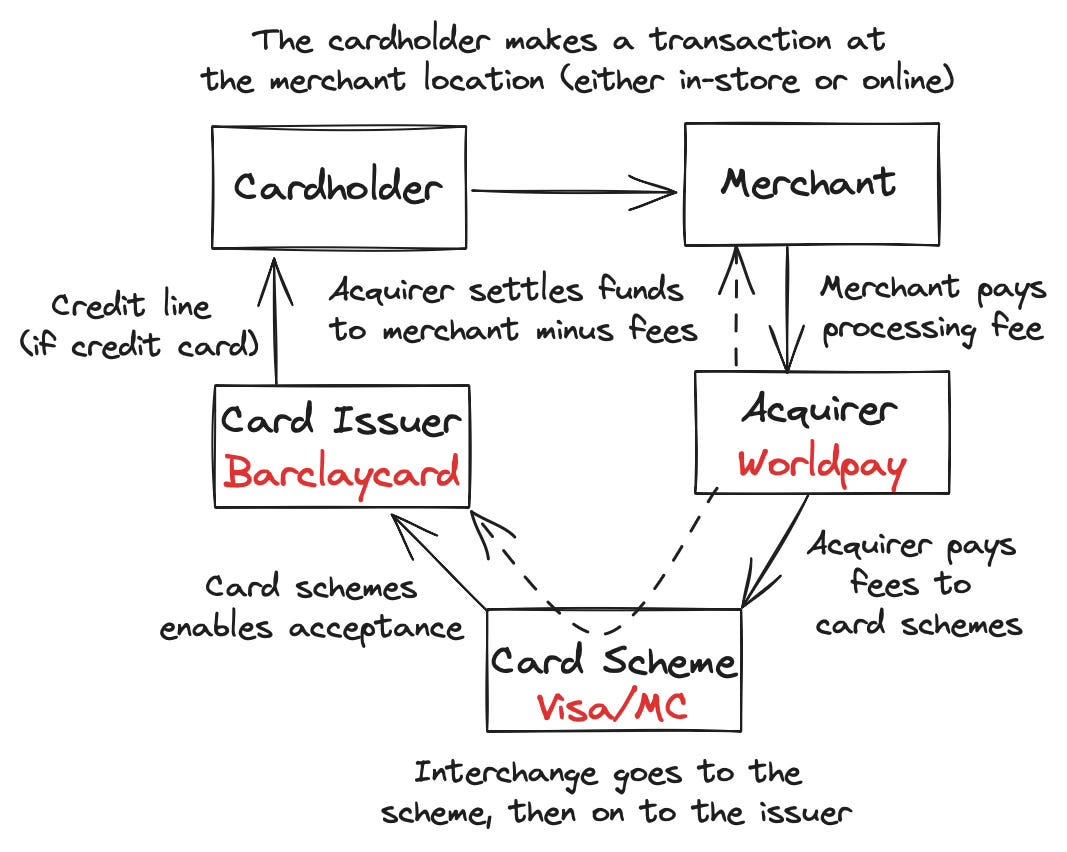
Consider how this model impacts a standard card payment transaction flow.
A transaction originates when a cardholder pays a merchant. What follows is the settlement of interchange and scheme fees to the card scheme4, and the cardholder gets debited for the transaction, with the merchant receiving funds net of any fees.
With a Curve transaction, the transaction flow differs.
From a cardholder perspective, it seems like there’s an additional step where the Curve card sends the transaction to the underlying card issuer.
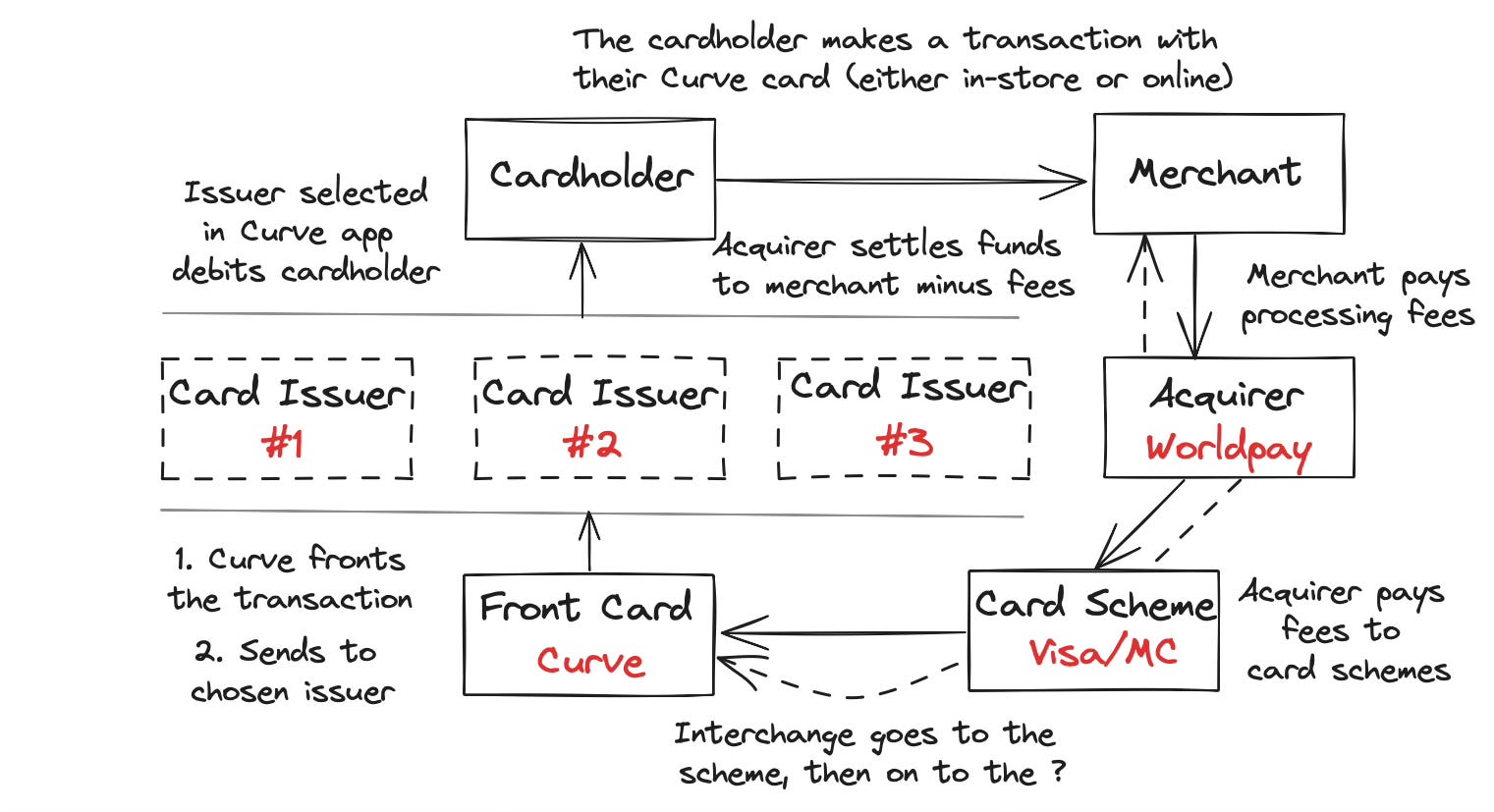
However, the above diagram is actually wrong ❌
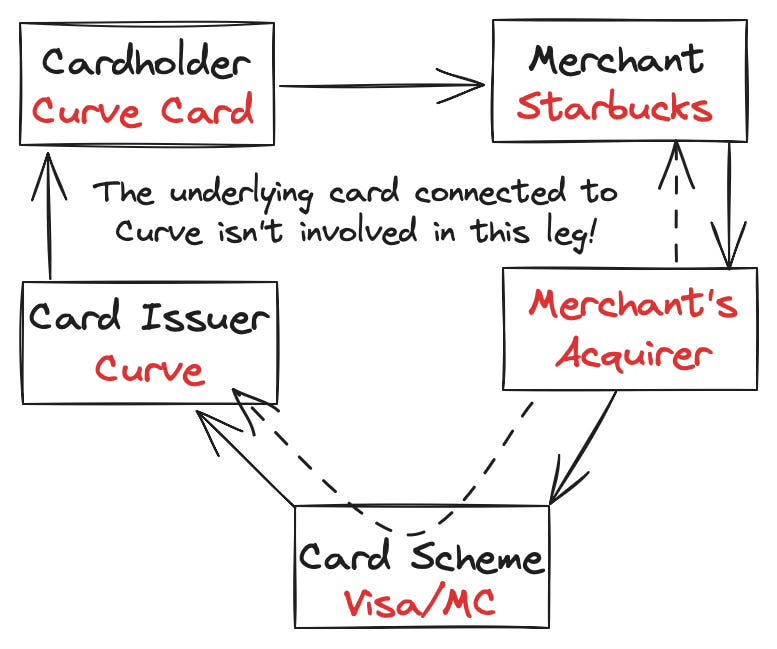
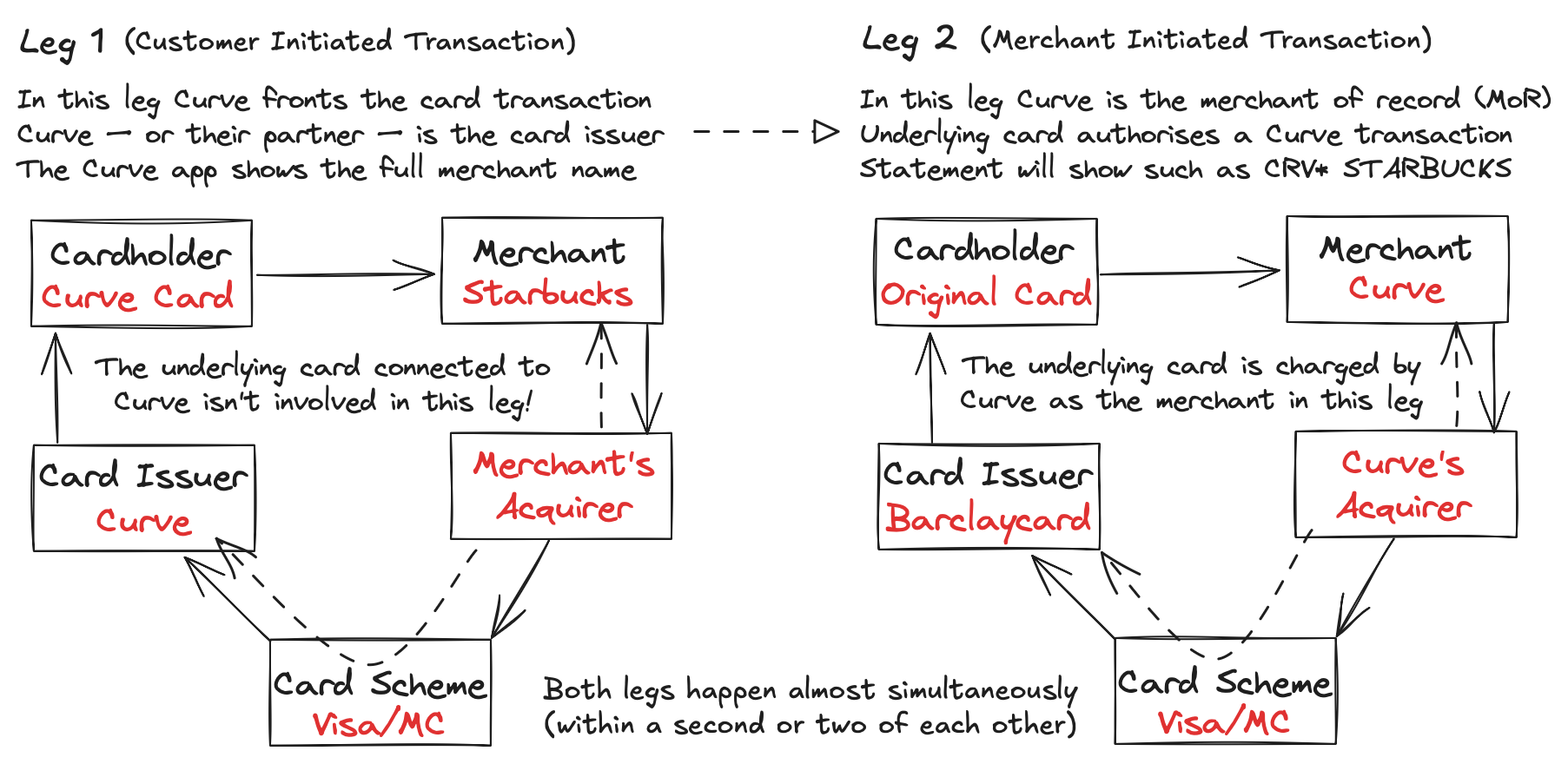
What’s taking place are two unique transactions. From a cardholder perspective it seems like a single transaction, but there are two legs. In order for Curve’s pass-through model to operate, two unique transactions take place almost instantaneously.
Leg 1 is what’s known as a Customer Initiated Transaction (CIT).
A CIT seems like a normal transaction initiated either in-store or online
But in this leg Curve fronts the transaction
This transaction is subject to Secure Customer Authentication (SCA) rules5
The merchant’s acquirer processes the transaction
And Curve — or their issuing partner — is the card issuer
The Curve app will show the full merchant name
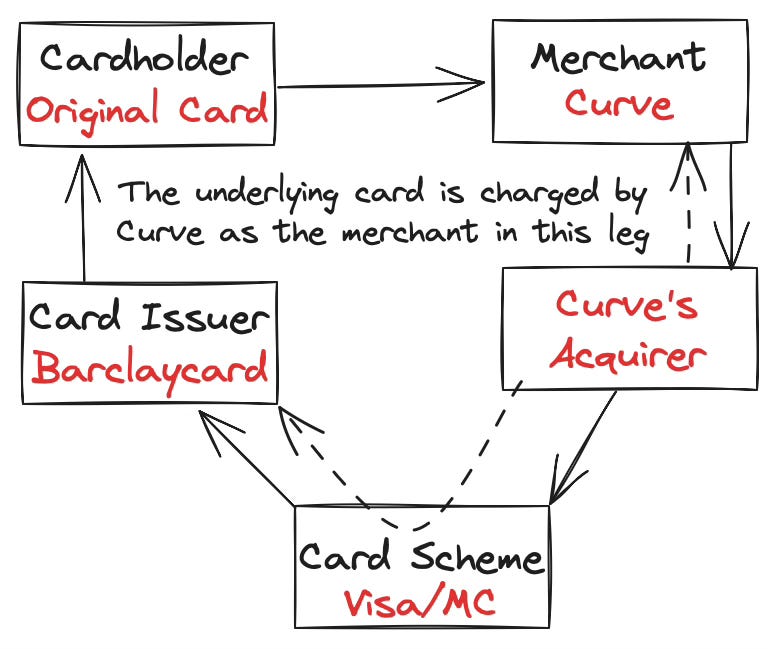
Leg 2 is what’s known as a Merchant Initiated Transaction (MIT).
The cardholder doesn’t see the MIT taking place
In this leg, Curve is the Merchant of Record (MoR)
This transaction doesn’t need cardholder authorisation, as the cardholder provided their permission to Curve to initiate such transactions when they added their card(s) to the app6
Curve’s acquirer processes the transaction
The issuer is the underlying card company or bank selected in the Curve app
The cardholder statement will show something like CRV*STARBUCKS
For card issuers, the downside of Curve’s model is that when Curve is used, they don’t get the level of information they expect, and are used to getting from each transaction. They know it’s a Curve transaction, but they don’t get merchant location detail, and even the full merchant name may not flow through. This lack of merchant-level information makes it hard for banks to detect fraud patterns and build customer profiles. On the other hand, Curve knows where you shop and how much you spend across the various cards connected to their app.
From a revenue perspective, Curve gains interchange revenue on Leg 1. In the UK and EU, this is 0.20% on debit card and 0.30% on credit card transactions.7 However, on Leg 2, Curve loses money. They have to pay the full set of acquiring fees as well as other related fees, such as any payment gateway costs. Additionally, if Leg 2 fails, Curve may retry the transaction, but if ultimately the transaction is unsuccessful, then Curve may bear a loss equal to the full transaction amount.
These factors mean that, structurally speaking, on a transaction-by-transaction basis, Curve’s business model is loss-making.8 The transaction economics mean that even if revenue per user rises through increasing interchange income, it won’t close the gap between top-line growth and profitability. To combat this, Curve expanded into adjacent areas and launched additional product lines away from this discrepancy between interchange income (Leg 1) and total fees (Leg 2).
