



Welcome to Payments Culture!
This newsletter explores how money moves, across borders and cultures, and how it’s changing.
After a short break it’s great to be writing again on Substack. Between now and the end of the year there’s lots of — hopefully interesting — content on the way.
Any comments or feedback are welcome. Feel free to leave a comment at the bottom of this post, or you can reach me directly via LinkedIn, Twitter (X), or email.
This week’s post is in collaboration with Arlen Agiliga, who writes the Substack The Economy, Stupid. His writing has been featured in publications such as The Diplomat, and his career experience includes working in investment banking in both New York and in Ulaanbaatar, Mongolia.

I start with a brief Q&A with Arlen, before his essay, which looks at consumption, credit and securitisation. It asks whether financial innovation is helping Americans afford more, or enabling them to consume beyond what they can really afford — something relevant in a world of fintech where credit is partly moving from cards to the point of sale.
Can you briefly introduce yourself and give an overview of what you usually write about on your Substack?
I’m Arlen, the creator of The economy, stupid., which is my Substack column where I write broadly on deals, global business and current affairs. The essay I wrote for Payments Culture has a deals and business focus, as it identifies a growing securitisation trend in American capital markets. I drew heavily on my experiences as a former financial institutions investment banker while writing ‘Everything for Sale (on Credit)’, and I dive into innovative financial products and the structure of capital markets in a few other essays on my Substack as well:
in ‘What Britney, Fannie, and Freddie All Have in Common’, I discuss the conservatorships of Fannie Mae and Freddie Mac and the politicisation of American housing markets;
in ‘When Capital Markets and Mother Nature Collide’, I discuss the growing market for catastrophe or ‘cat’ bonds and insurance-linked securities;
and in ‘The Quiet Rise of UnionPay’, I chart the development of UnionPay, China’s state-owned payments firm and the operator of the world’s largest card network, and discuss the role of industrial policy in services businesses.
In addition to starting my career as a financial institutions group (FIG) investment banker, I have also worked as a generalist investment banker at international boutiques and as an associate at a frontier and emerging markets private equity firm.
Having worked in both Asia and the West, what are some of the key differences you’ve noticed in how consumers approach credit? And some examples of this.
Looking at macroeconomic data is helpful here. Take America, China and Japan as examples just to illustrate the point. America, China and Japan all have relatively high levels of household debt (they have high household debt-to-GDP ratios). But in addition to high household debt, both China and Japan have incredibly high household savings rates, whereas America’s household savings rates are rather low.
The difference in savings rates despite high debt levels across each economy is not just because Asian people culturally like to save more (although that could be part of it). The difference is also driven by the diversity of financial products and types of credit available to consumers in each economy, which comes back to the point I make in ‘Everything for Sale (on Credit)’: the American economy has been engineered to make consumption frictionless, whereas many Asian economies have not.
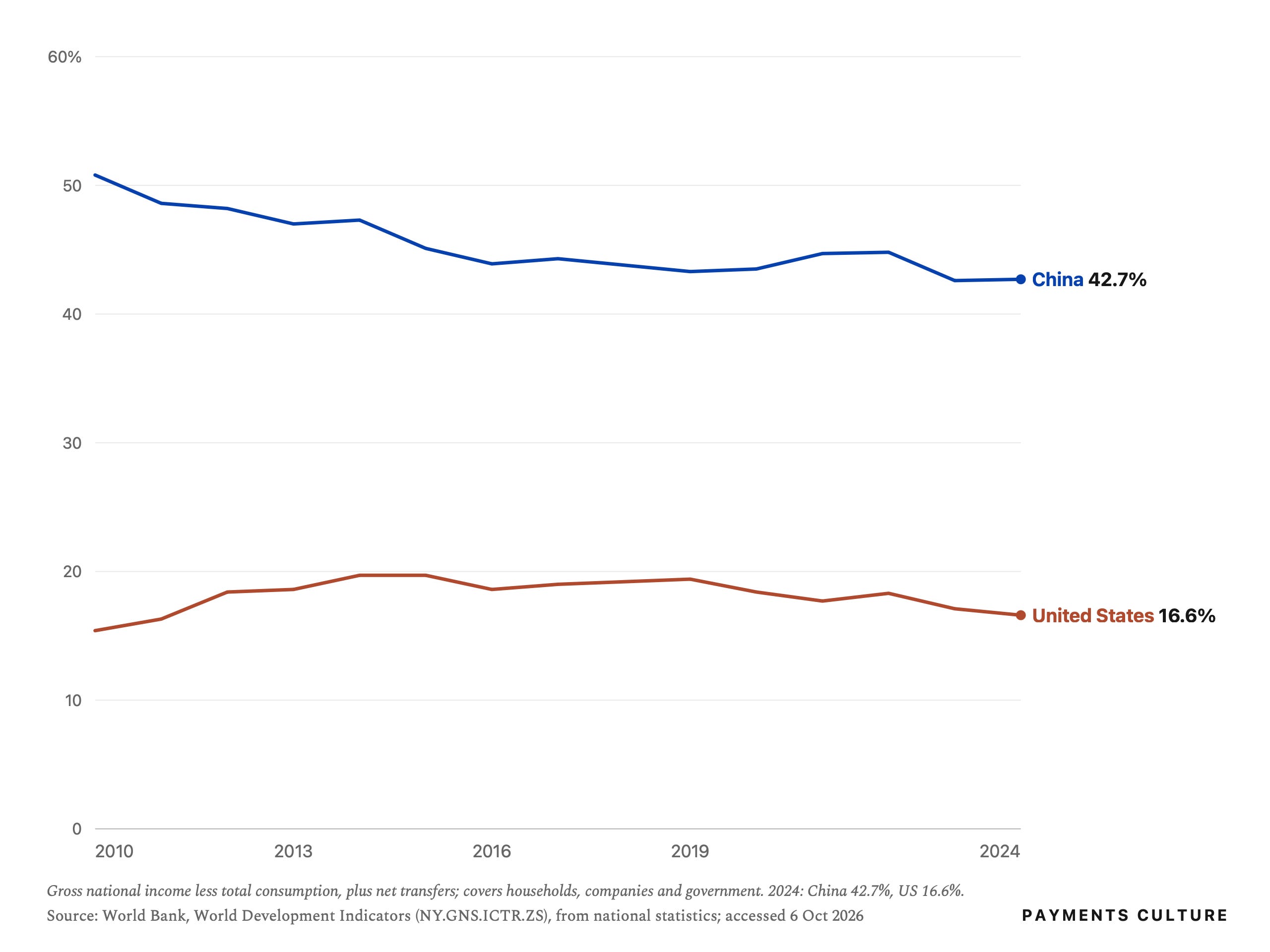
Flexible consumer financing is an instrumental part of the frictionlessness of American consumption, and the lower savings rate in America relative to Japan and China despite comparable levels of debt is enabled by American households’ ability to more readily convert their assets to cash, due to America’s diversity of consumer finance products and deep capital markets.
So whereas American consumers tend to use accumulated income to purchase assets and then finance those assets to fund further consumption, Asian consumers tend to lock up their income in savings as they accumulate more assets and become wealthier. This makes Asian consumption more elastic than American consumption (in the short-to-medium term). I think that’s the fundamental difference in how consumers approach credit across Asia and the West. Of course, there are so many country-specific caveats that this question is impossible to answer succinctly, but hopefully my answer gives you insight into how I think about these things.
It seems that these days with BNPL and other fintech products offer the opportunity for consumers to garner credit instantly at the point of sale — as opposed to in advance, eg with a credit card. Is this something that should concern us? Or can it be a positive for consumers?
I think it can be a positive for consumers if they engage prudently with point-of-sale or instant credit, but I also think the burden of estimating creditworthiness should fall on the firms doing the lending, since they are incentivised to ensure that their borrowers can actually repay the loans for which they are approved. The average American consumer will always be happy to receive a new line of credit, but if the lending firm cannot accurately gauge the borrower's ability to repay, then their lending model is flawed. And given the nature of the lending, firms engaged in BNPL, point-of-sale and instant lending should really be the best at gauging creditworthiness, since their businesses depend on making accurate decisions quickly.
Was there any particular moment when you noticed what you call “the securitisation of everything”?
The impetus for the idea came from a headline I saw that said Apple planned to lease iPhones for $17.99 a month through a partnership with Klarna. Product leases are a textbook securitisation strategy for high-volume, high-value retailers like Apple, and it was in that moment that I realised this was an idea worth writing about. I have also seen the BNPL taco memes in various places across the internet, but the Apple–Klarna headline helped me form a deeper idea related to the same sentiment.
How to you see consumer credit developing in the next decade? If BNPL was the key innovation of the past decade, what do you think we’ll see in the next?
I think credit will become even more widely available, and that alternative data will play a bigger role in assessing creditworthiness, with credit scores giving way to more granular measures of a borrower's ability to pay. AI, blockchains and other emerging technologies (like agentic finance) will all help drive these changes, which aim to make consumption stickier and more consistent from period to period.
Thanks Arlen!
