


This newsletter explores how money moves, around the world, and how it’s changing.
This week we’re looking at payments in emerging markets.
The past five years have seen digital payments accelerate to such an extent that many markets that were once predominantly cash only are now almost cashless, though not in the way most of us in the West would imagine.

So what’s happening? Well, in some places the move from cash to cards seemed inevitable. It took time but happened almost effortlessly.
From their home market of the US, Visa and Mastercard branched out to Canada, the UK and Australia. Other Western European countries soon followed, although in places such as France and Germany, Visa and Mastercard grew at a slower pace, often due to the domestic card brands that they had to contend with. Emerging market economies grew rapidly in the 2000s and 2010s and it was easy to think that all markets would go on the same cash to card trajectory. The international card brands had well-honed infrastructure that they could take to emerging economies.
However, as I wrote last year, the bifurcation of payments has taken place.
The past quarter of a century saw expectations change. We once anticipated that Brazil, China, India, Indonesia, and beyond would be great growth opportunities for Visa and Mastercard, yet in emerging markets new payment types and new payment rails emerged. Whether it be Pix in Brazil or Unified Payments Interface (UPI) in India, local payment methods — including local card brands — are now the dominant way to pay in emerging markets.
The expected path from cash to card has become cash to mobile digital payments in much of the world.
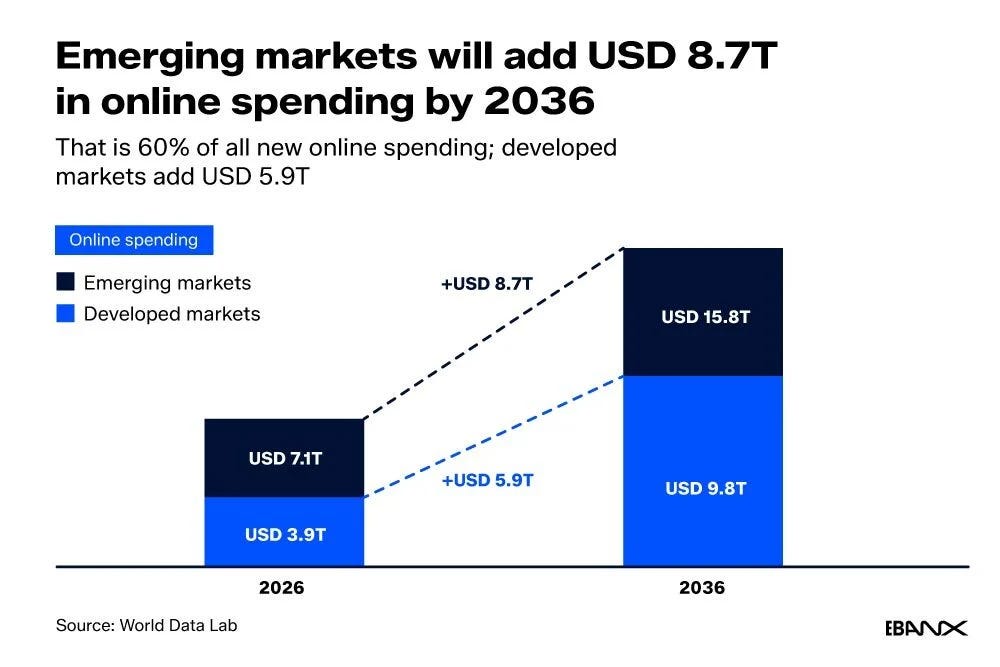
A recent study by World Data Lab (WDL) and EBANX highlights some of the key trends associated with the growth of online spending in emerging markets. Not just the fact that e-commerce growth is mainly happening on local payment rails, but also some of the key demographic shifts: for instance the study found that “e-commerce in emerging markets is entering a demographic transition”, with those aged 45 and over accounting for 51% of the increase in annual online spending between now and 2036. This increase will amount to $4.4 trillion across emerging markets; according to WDL this will be more than the total annual online spending in developed economies today, which amounts to $3.9 trillion — highlighting the scale of the increase in this cohort.
Other key statistics from the study include:
Online spending by those aged 65 and over is expected to grow at 12.2% a year, compared to 8.7% for those aged 15-29. Although, in value terms this equates to growth of $1.9 trillion for each demographic. Highlighting that the younger cohort had a head start with their e-commerce habits.
Of the 834 million new online buyers worldwide between now and 2036, only approximately one third — 281 million — will have a credit card.
By 2036, on average, only 20% of adults in emerging markets will hold a credit card, compared to 66% in developed economies.
“The cross-border buyer today is young, mobile-first, lower- to middle class, and often buying online for the very first time. In the next decade, growth will come from older, middle- to upper-middle-class consumers — but they will not arrive with credit cards either. They will pay exactly the same way today’s young buyers do: on local rails. That is the most important point.” - Estelita Hass, Head of Market Intelligence at EBANX
Structural reasons play a part in explaining the variances between payment habits in emerging market and developed economies — WDL research shows that this gap is visible today. For instance, while credit cards are held by between 3% and 26% of adults across emerging regions, mobile phones are owned by between 76% and 95% (in each case, the numbers represent the regions with the lowest and highest share of ownership).
In lieu of credit cards, mobile has made a difference, and the ability to operate mobile first has been a key facilitator in the growth of local payment rails. Many of the popular payment methods in emerging markets function via QR codes. QR codes can operate without a high-end smartphone. Transactions can be completed on a device costing $100 or even less.
Some QR code-based payment methods are tied to a bank account, whereas other solutions such as GoPay, Dana, or OVO in Indonesia are e-money solutions. The local QR code system in Indonesia, known as QRIS, accepts payments directly from bank accounts or from non-bank wallets. To ensure financial inclusion users can top up their e-money solutions with cash at some supermarket chains. Compare this to paying with Apple Pay: you’ll need an iPhone ($500+); linked to a credit or debit card; and the merchant will need a payment terminal capable of accepting a contactless payment.
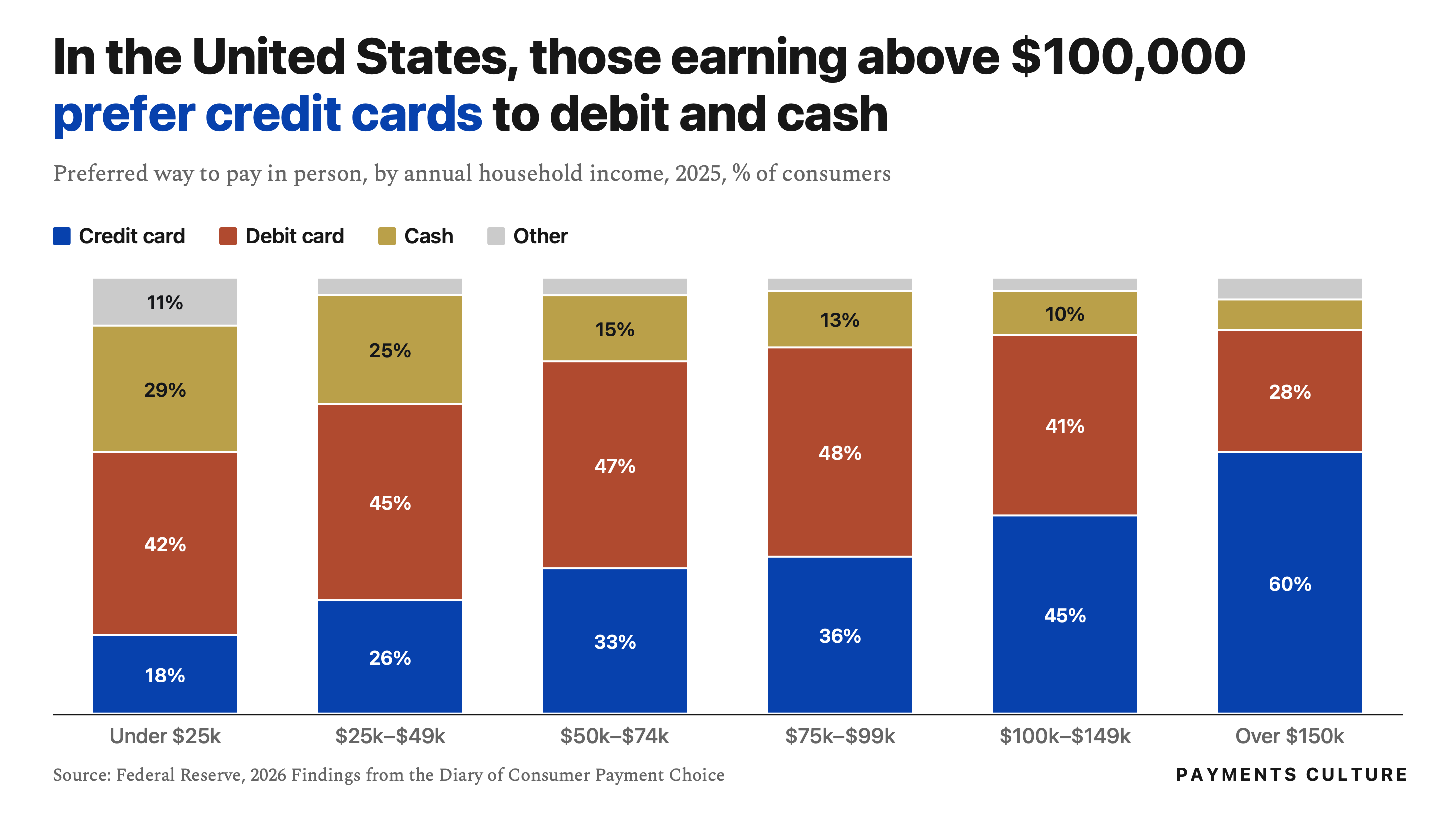
As illustrated above, in developed economies, and especially in the United States, consumers tend to opt for credit cards more and more as their income rises. As a consumer’s credit worthiness improves they can get a bigger credit line and higher end card, which means better rewards — paid for via the high interchange fees that merchants pay. In emerging markets regulators keep fees low across most payment types, rewards are low, credit is harder to come by, and many consumers prefer to pay via instalment payments rather than via revolving credit (more on this later). Data from the World Bank shows that in India less than 5% of adults have a credit card, and as we’ve seen, WDL projects that by 2036 only 20% of adults in emerging markets will hold a credit card, this compares to the US where credit cards are almost ubiquitous: 82% of adults have one, 86% of those 45–59, and 92% of those aged 60 and over.
India’s digital payments push
While India has relatively few credit cards, it does have UPI — a payment system so popular that it saw 228 billion transactions in 2025. As a comparison Faster Payments (UK) and ACH (US) managed 4.7 billion and 35.2 billion respectively. Of course UPI does have a much lower transaction size than the other systems referenced; the average transaction value now sits at $15 (₹1,313), and has reduced from approximately $24 (₹1,794) over the past five years. This low transaction size reflects part of the success story. UPI is embedded within retail, from street stalls to larger stores, and in the process has mainly replaced cash. UPI's 500 million users averaged 457 transactions each in 2025, meaning that an average user is paying with UPI more than once a day.
India will add 334 million middle-class consumers by 2036. WDL projects that emerging markets in total will add 930 million middle-class adults by 2036, two-thirds due to rising spending and a third due to population growth. Therefore India is by far the biggest contributor to the growth in the middle class cohort in emerging markets.
By 2036, 82% of India’s recurring online spending, some $167 billion a year, will come from adults without a credit card, according to WDL. UPI AutoPay will emerge as the default payment option for recurring payments especially in areas such as AI tools, SaaS, online education and digital entertainment.
One major global AI company added more than 4,000 new customers per day during its first three months in India after enabling UPI AutoPay through EBANX.
Another key aspect of payments in India is the role of RuPay. This is a local card scheme run by the National Payments Corporation of India (NPCI), the same organisation that runs UPI, as well as other aspects of India’s retail payment systems. RuPay can be either debit or credit, and from September 2024 banks have had to offer consumers the choice of card brand when taking out a credit card. This, alongside the fact that RuPay can be linked to UPI, allowing cardholders the ability to spend with credit via a UPI QR code, has meant that RuPay has grown its share of credit card spending from 3% to 18% in three years to the end of 2025.
For online payments, local card schemes offer increased market penetration and the ability to utilise local acquiring. EBANX notes that local acquiring often means fewer transaction declines as issuers are more likely to approve transactions processed domestically. As well as RuPay other notable domestic card schemes include Troy in Türkiye, Elo in Brazil, and Verve in Nigeria.
Recurring payments make a difference on Pix
As payments rails mature it’s natural that their functionality evolves and grows. This especially happens in markets where the product is managed by a central authority with a clear mandate; for instance in Brazil, the central bank, the Banco Central do Brasil (BCB) owns the Pix product roadmap and operates the payment rail. This contrasts with some Western account-to-account payment rails and schemes where ownership of the rails, the scheme rules, and product roadmap often involves a more disparate array of stakeholders.
Pix Automático, launched in June 2025, illustrates this point well. Previously recurring payments were offered mostly via cards. Pix overtook both debit and credit cards in Q1 2022, and overtook credit and debit combined in Q1 2023. With Pix the default way to pay for most consumers, the onus was on the BCB to deliver recurring payments on Pix to open up new use cases, and show the benefit of a system designed with functionality, ease of use, and financial inclusion in mind.
Renato Gomes, Director of Financial System Organisation and Resolution at the Central Bank of Brazil emphasised the financial inclusion point at a launch event for Pix Automático:
Today, you need a credit card to subscribe to streaming services, and many consumers are excluded from e-commerce products precisely because there is no payment method that, let’s say, bypasses the card ecosystem and reaches consumers who only have a bank account or a low credit limit. So this aspect of financial inclusion will be very important for consumers.
(translated from Portuguese)
So how does Pix Automático work? Recurring payments are authorised and managed via the customer’s financial institution with clear rules for retrying failed payments.
Below: Brazil’s Central Bank publishes many helpful explainer videos in a modern and informative style. It’s rare to see Central Banks, regulators, or other such institutions communicate in this clear way, which may be part of the reason for Pix’s success.
Under the Central Bank’s rules (Resolução BCB nº 402, July 2024), a customer’s bank must allow a user to see:
all active authorisations (which merchants are currently authorised to take funds).
all scheduled payments (the next payment due under each authorisation including date and amount).
And also, in their banking app, the user must have the ability to manage their recurring payments:
the ability to cancel any authorisation.
the ability to set a limit per recurring transaction, with some banks offering a total recurring payments limit.
This level of transparency is rare and often missing from recurring card payments in developed countries. In my opinion this is the benefit of building products with an API developed from both a consumer and merchant lens at the same time. There is no third party issuer involved so information flows directly from the merchant to the user’s bank through the central bank system (as do all Pix transactions).
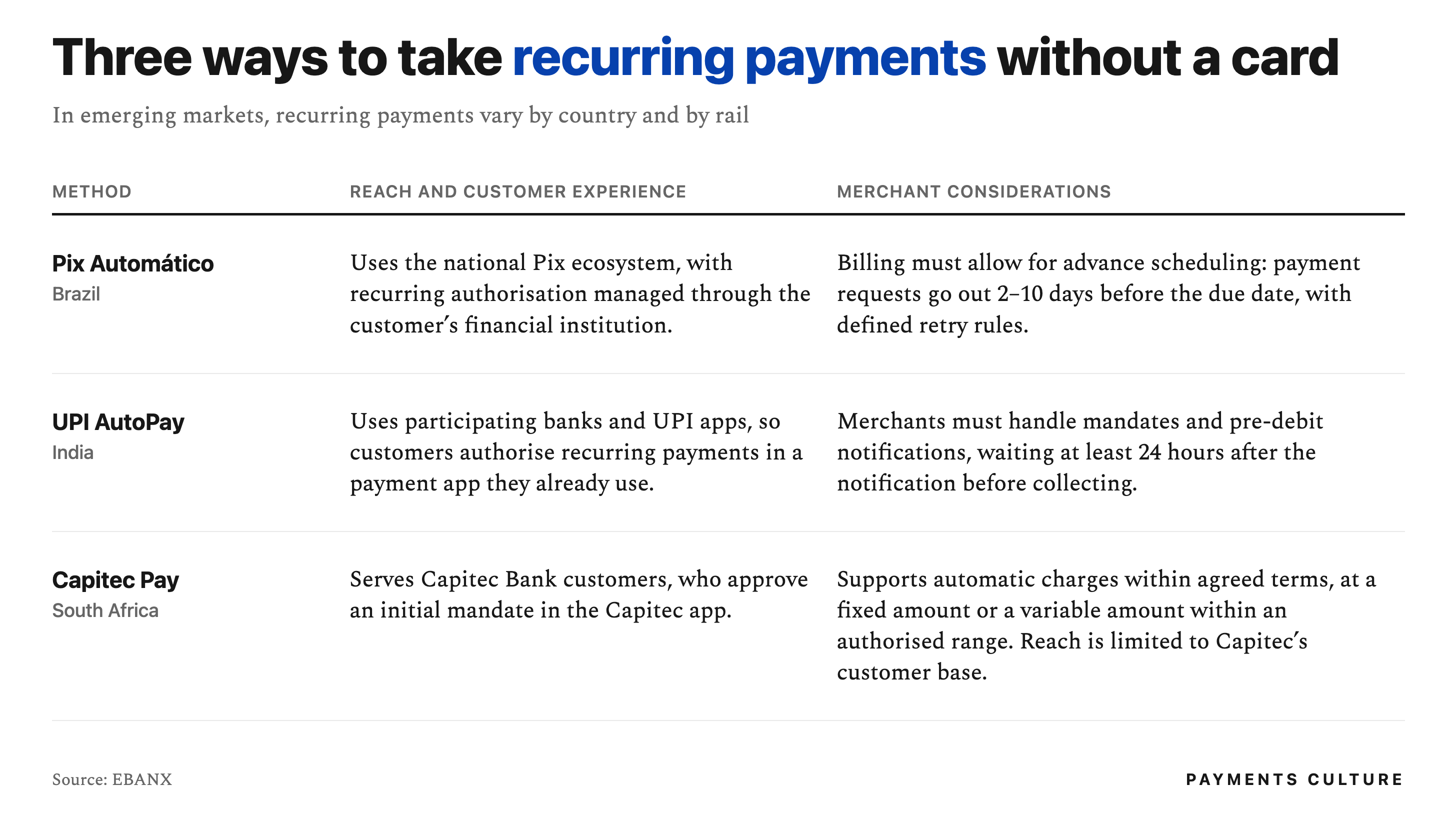
At this time EBANX’s recurring payment offering for local payments spans 12 countries across Asia, Africa and Latin America (Nequi Recurring in Colombia and Yape Recurring in Peru were added earlier this year). This functionality allows merchants whose businesses are suited to subscription payments to sell directly with payment methods used by more than 1 billion people. Lastly on this topic, for recurring payments one interesting case study worth mentioning from Brazil: Nord Security, the cybersecurity company, now takes 28% of its revenue in Brazil through Pix Automático, with approval rates 20 percentage points higher than for credit cards on merchant-initiated transactions.
Meeting consumer expectations
Klarna made instalment payments popular in Europe and the US, but the ability to pay in three or a variety of other variations on the concept have been the norm in many places for some time, often utilising a consumer’s existing card rails rather than via a separate provider.
In Argentina consumers often use monthly instalments via cards to manage household budgets and the effects of inflation. Naranja X is a local fintech that serves more than 9 million users and has issued over 16 million cards across its portfolio. Naranja means orange in English so perhaps unsurprisingly its card is coloured accordingly, actually it looks similar to Monzo’s famous hot coral colour. For instalments the company offers its own closed-loop card as well as Visa and Mastercard cards.
Inflation in Argentina was 31.5% in 2025, down from 117.8% in 2024, therefore it’s no surprise that consumers are interested in locking in prices at the time of purchase — even if there is a charge for credit, it will still often make financial sense. Naranja X and other providers such as Cabal know how consumers earn, borrow and repay locally. As well as Argentina, Chile is another market in which instalments earn their place. EBANX data found that offering instalments in the country led to an increase of up to 30% in total payment volume.

“If you are a merchant running a digital business, this is the number you need to bring home: between 52% and 59% of all online spending today — not by 2036, today — comes from adults who don’t own a credit card. The myth that the lack of cards is preventing consumers in emerging markets from purchasing is gone. The real barrier is when merchants rely solely and exclusively on cards at checkout.” - Marie-Elise Droga, Chief Revenue Officer at EBANX
In order to succeed in emerging markets it’s important to understand the trends outlined above.
Consumers in emerging markets will grow in importance for international merchants, yet their preferred way to shop will not be via cards, or when it is, it will often be via local schemes as opposed to international card brands. This trend for local rails is only growing. In Colombia, Nequi, a local fintech platform, has become a verb. The phrase ¿Me pasas por Nequi? (“Can you send it to me via Nequi?”) is used to split a bill or buy from a street vendor. The company has over 20 million monthly active users, essentially half of Colombia’s adult population.
This provides another example of how understanding the best ways to sell into markets whose consumers will make up 60% of new online spending by 2036, and worth $8.7 trillion a year, should be top of mind for those selling internationally. A checkout that only asks for a card number will not be enough.
Thanks for reading!
Research in partnership with EBANX

Please consider sharing this newsletter with a friend or colleague if you enjoyed reading this edition. If you are not yet a subscriber please sign up below for a free or paid subscription.
Note that views expressed on this Substack are my own and do not represent any other organisation. Also nothing I say should be taken as investment advice.