


Let’s hit the nail on the head right away. Banks and fintechs love the FIFA World Cup as it’s about far more than football.1 The World Cup gives brands global exposure unlike any other event. Every four years literally billions of people around the world watch the World Cup — far more than watch the Super Bowl, or anything else.2 And the World Cup is, by its very nature, a global event.
The exposure you can get from New York to Paris to Beijing is unrivalled, and football’s superstars are global celebrities. Some players are already well-known around the world. (Ronaldo has far more followers on Instagram than any President or Prime Minister.) Other players that some viewers might have never seen play before will explode onto living rooms in this World Cup with a stunning goal and go on to be the next big name player in one of Europe’s top leagues.
Getting associated with a big name player, a national team, or even better, a very successful, or better still, the winning national team, is great for any brand. This includes banks, payment companies, fintech, e-commerce firms and others.
The level of exposure is one thing but there’s a huge cultural significance too.
Growing up in a pre-Instagram era many of us millennials heard of, and got to know Brazil through the nation’s football team that won the 1994 and 2002 World Cups (France won in 1998). I remember wearing a Brazil replica shirt to school in the summer of 1994 long before I knew about the Copacabana, bossa nova, caipirinhas, or samba . Perhaps these picks are too cliched! But my point is that, back then, football was how I got to learn about the nations of the world.
These cultural and historical angles to the World Cup are often not discussed retrospectively. But in the moment they add a vital dimension. Adding another lens, that of fintech and banking gives a useful perspective too. Events with a global and a local reach are powerful for financial services. Grow your brand on the world stage and advocate for your national champion at home too. Football is the world’s most popular game and some examples can highlight that fintech doesn’t exist in a vacuum. This gets pieced together in what follows.

During the Cold War, Europe was divided in two. Berlin, modern Germany’s capital, was at the centre of the division. The Berlin Wall symbolised the struggle of the era. The three-and-a-half-metre-high, forty-three-kilometre-long wall cut the city in half. But it wasn’t only Berlin that was divided, Germany itself was split between East and West. Two separate governments, two political systems, two geopolitical alliances.
Two countries meant two national football teams, and in football the divide was stark.
In 1954, 1974, and 1990, West Germany won the World Cup. Additionally, West Germany, or to give its official name, the Federal Republic of Germany3, known in German as the Bundesrepublik Deutschland, were losing finalists on three occasions — in 1966, 1982 and 1986. East Germany only qualified for one World Cup, the 1974 tournament. They dramatically beat West Germany in a group game, and actually topped the first group, but went out in the second group stage.4
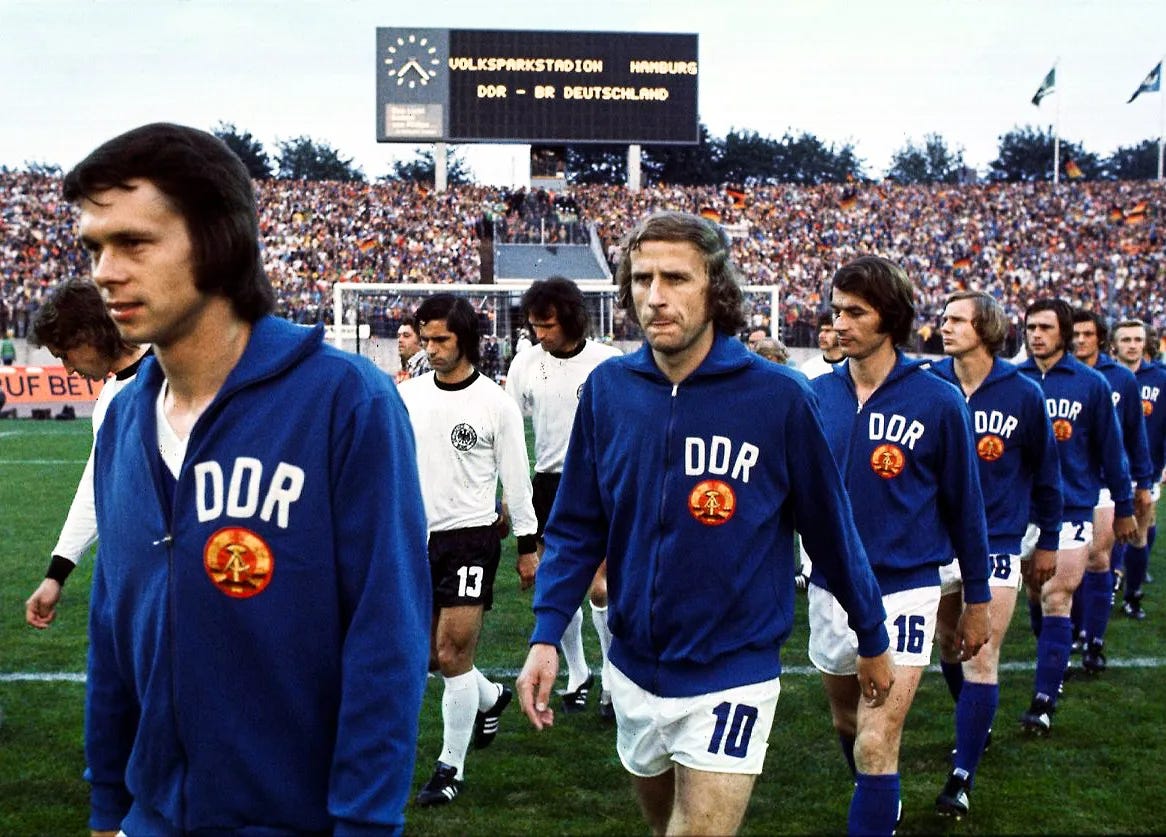
In 1989 everything changed. The Berlin Wall fell. Families who had not seen loved ones, in many cases for decades, were able to meet again. Then, 11 months later in October 1990 Germany formally — legally and politically — united as one nation for the first time since 1945.
This meant that the 1990 World Cup, which took place in Italy, had a strange dimension.5 West Germany competed and won the World Cup. But despite the fact that the Berlin Wall was no more, Germany had not yet reunited. The fate of the “two Germanies” was still under discussion. Full German sovereignty only arrived when the US, France, the UK, and the USSR worked with the two German governments to agree a way forward.
In a documentary I recently watched called Italia 90: Four Weeks That Changed The World. In the documentary German football legend Jürgen Klinsmann, reflecting on the 1990 World Cup, mentions that as a player it felt as if all of Germany were supporting the West German team that year.6 On the way to the final he recalls seeing fans from both East and West uniting under one German flag7 and supporting the team together. This is a clear example of how football can transcend sport. In fact Klinsmann mentions that the success on the pitch may have helped catalyse the reunification that followed a few months later.
In 1994, for the first time since 1938, a unified Germany took part in a FIFA World Cup. The tournament was the first held in the United States. It was also the first World Cup featuring the back-pass rule, and the first World Cup in which a win in the group stage was worth 3 points.8
This year the United States is hosting the World Cup again. But this time there are three host countries: Canada and Mexico are also hosting — this is a first, until now there’s never been three host nations. In 2002 Japan and South Korea co-hosted the World Cup but otherwise it’s been a one-host effort.
The 2026 FIFA World Cup has many other firsts:
The first World Cup with 48 teams9
The first time a country has hosted the World Cup for the third time — Mexico10
The first time that Canada has hosted a men’s World Cup11
And four countries are playing at a World Cup for the first time: Uzbekistan; Jordan; Cape Verde; Curaçao.
Amazingly, two of the new qualifiers have less than 750,00012 citizens between them. Cape Verde has a population of around 530,000 and Curaçao has a population of only 185,000. Yet eight of the world’s ten most populous countries representing 4.1 billion people either did not qualify, or are banned from taking part.
With their population ranking in brackets: India (1), China (2), Indonesia (4), Pakistan (5), Nigeria13 (6), Bangladesh (8), and Ethiopia (10), did not qualify for the 2026 FIFA World Cup, and Russia (9) is still banned from taking part.
Of the world’s ten most populous countries, only the United States (3) and Brazil (7) are playing at the World Cup, and one of them — the USA — qualified automatically as a host nation. Brazil topped the South American qualifying group, but they underperformed again at the tournament itself. Norway beat them in the round of 16 earlier this week. Brazil were never one of the favourites,14 though they’ll be disappointed not to have not gone further.
So why do so many of the big nations struggle? The above video looks in-depth at the challenges of football in India. From a China lens The Economist recently had a podcast episode titled Why China still sucks at football? The world’s fourth most populous nation, Indonesia, has not made it to a World Cup finals tournament since independence, although the Dutch East Indies played in 1938 (as Indonesia was known in the colonial era), losing 6-0 to Hungary in the first round and then exiting the competition.15
One theory is that while big countries can deploy substantial money and resources, success in football, both at a domestic and international level, cannot be imposed top down. Countries who want to do well on the international stage need to allow the domestic game to evolve and mature over time, which in turn feeds into the international team’s performance.16 There’s no shortcut to success. For countries seeking prestige and success this realisation can be tough.17 Yet influence can be found not just on the pitch but off it as well. Let’s get to the money.
Before we continue…
Payments Culture is a newsletter about how money moves, around the world.
It comes with:
Expert perspective from my 15+ years working in the industry
Real-world stories that go beyond the headlines
Market intelligence you won’t find in press releases

What some of my readers have said about this newsletter:
Matt brings theory to life by using his personal experiences to explain the world of payments. The name ‘Payments Culture’ reflects this intersection perfectly.
Oh man, for what it’s worth, your newsletter is the only one I read regularly. Love your storytelling!
The Payments Culture newsletter is super practical, written in normal non-tech language with a solid amount of depth while remaining high level. Your detailed yet high-level style is a writing gift not everybody has.
Readers of this newsletter work for organisations such as:
Visa, Mastercard, JPMorgan, Stripe, Adyen, American Express, Checkout.com, Block, Revolut, Wise, Robinhood, Plaid, Marqeta, Affirm, Airwallex, TrueLayer, Barclays, Andreessen Horowitz, General Atlantic, Tiger Global, Bessemer, Advent International.
If you’d like to support this newsletter you can upgrade to a paid subscription.
The World Cup comes with an unmatched plethora of sponsorship opportunities.
Banks and fintechs can capture the eyes of the world via the beautiful game and one of this year’s debutants, Uzbekistan, where interest in the tournament is particularly high, clearly illustrates the potential for brands to make their name known both at home and abroad. UZCARD, one of the country’s local payment systems18 is the main sponsor of the Uzbek Football Association (UFA). In Uzbekistan locals usually pay via UZCARD or HUMO rather than with Visa or Mastercard.
As well as UZCARD’s sponsorship, fintech and e-commerce provider Uzum is also an official partner to the UFA. The company has been on a roll, raising a $130m investment round earlier this year, at a $2.3bn valuation, in a round that included Tencent. Uzum announced last September “[we] will support the preparation of the national team for the World Cup as well as the development of football across the country”. Supporting the national team but also investing in developing football infrastructure is clearly good for the brand.
As well as sponsorships at the UFA level there’s also activity at the level of individual players. Most notably with Uzbek national team captain Eldor Shomurodov working directly with TBC Bank Uzbekistan (TBC UZ) as a brand ambassador to promote football in the country. TBC UZ is the country's leading digital bank and has scaled to more than 22 million registered users — roughly half the country are customers.
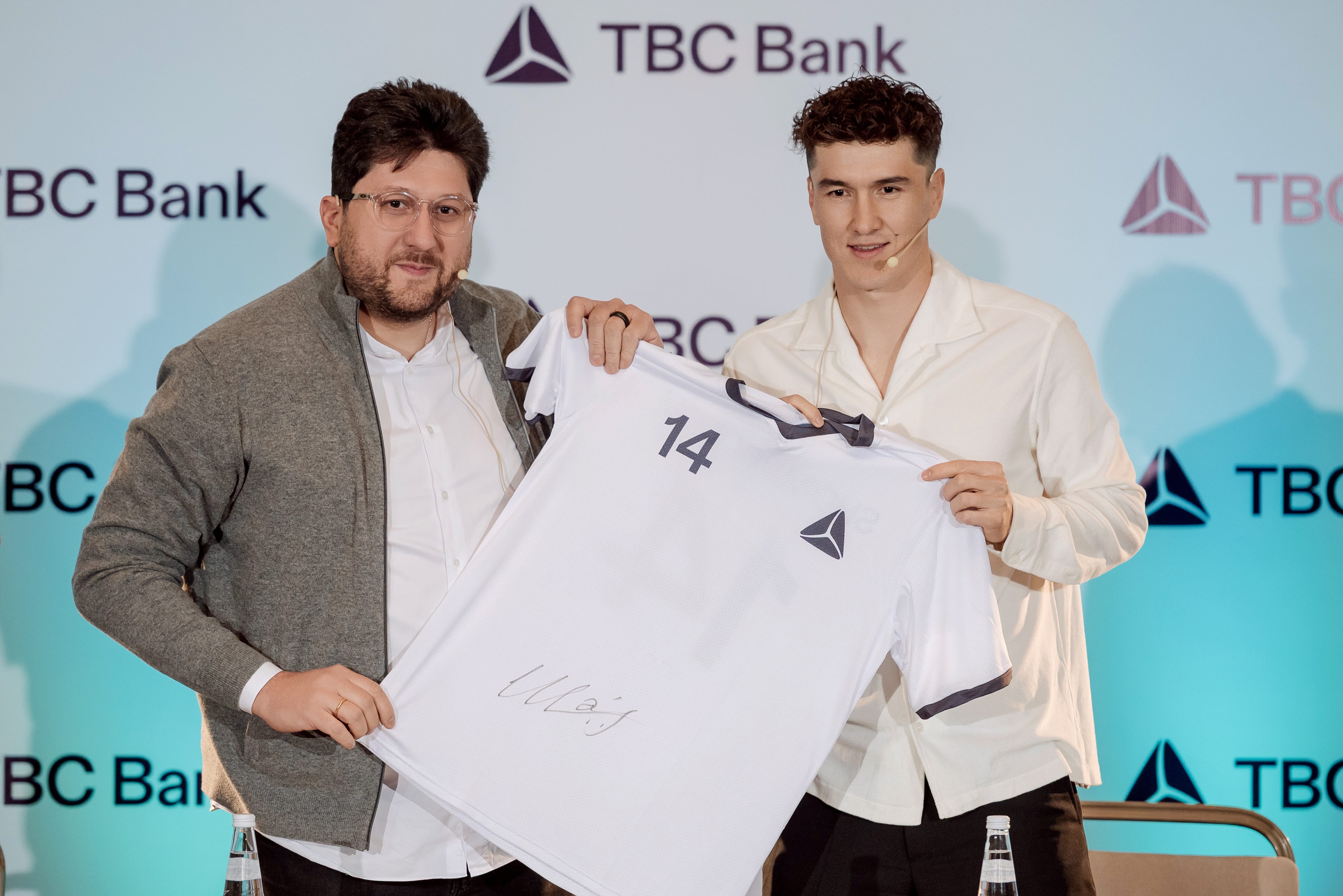
All this takes place while the Uzbek government is pushing for greater private funding of domestic football and away from the state-funding model which has predominated the professional game so far. Something which Nikkei Asia explored in-depth last month. Additionally the BBC World Service recently featured a video segment on Uzbek football and the World Cup frenzy that’s been taking place in the country — highlighting that World Cup qualification has been a source of national pride.
Between writing the above section, and editing and publishing it, the group stage ended and it’s safe to say that Uzbekistan’s World Cup wasn’t successful on the pitch. They lost every game of the group stage. Though getting to the tournament in the first place was a success in itself and they will be looking to build on the achievement of their first qualification in future World Cup competitions. Sometimes successfully exiting the group stage takes a country a few attempts!
Meanwhile, while China did not qualify for the World Cup, Chinese brands are harnessing the World Cup as a means to build awareness outside of their home market. This shows how sponsorship can serve multiple purposes. For instance there’s the ability to build awareness of the company and its products in the short-term, build long-term brand equity (consumers keep seeing a brand at events over time and this adds credibility), and also the important but less discussed aspect of sponsorship: strengthening engagement with organisations such as FIFA. In essence, sponsoring an event like the World Cup is not a one event pitch, it’s often a multi-layered plan many years in the making where influence is garnered over time.
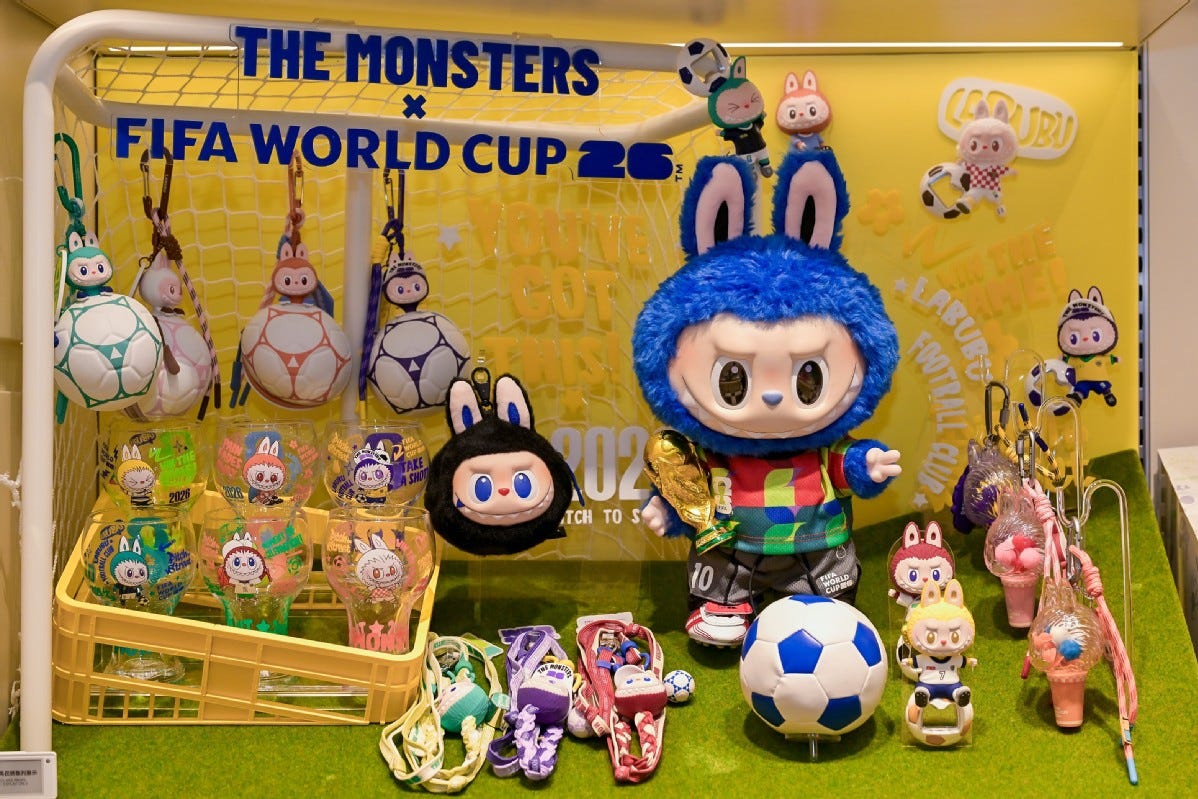
The Chinese influence was apparent from the tournament’s opening ceremony, during which, two Labubu characters, from the Chinese brand POP MART, made an appearance on the pitch. Millions watching round the world would keenly recognise the characters created by Hong Kong-based artist Kasing Lung, and millions more would be asking their younger relatives to explain the importance of these life sized plushies as they strolled around the pitch as part of the on-field entertainment prior to a ball even getting kicked.
Then there’s Mengniu, the official dairy sponsor. The company’s name is written in Chinese characters “蒙牛” on billboards within the stadiums, so the sponsorship will be picked up mostly by Chinese fans rather than international viewers. Yet Mengniu is part-owned by a state entity COFCO, giving the partnership an added political dimension. Mengniu’s involvement with football is clearly long-term. They’ve signed up as a sponsor for the 2030 edition of the World Cup, and also the 2027 Women’s World Cup.
In a move described as going beyond brand exposure to technology enablement19 some partnerships are going beyond the billboards. Take Hisense, whose technology is powering the screens for the assistant video referee system, and Lenovo, whose technology will “power FIFA's Intelligent Command Centre”, a real-time operational hub designed to support tournament management before, during and after matches.
I wrote in 2024 in a post titled Alipay+ and Chinese brands at Euro 2024 that despite the Chinese national team not taking part, Chinese brands were prominent at the championship.20 Ant International, part of Ant Group, whose domestic business is responsible for the AliPay superapp in China, was one of the main sponsors of the Euros. One of Ant International’s key products, AliPay+, which acts as platform to connect various mobile wallet systems, was everywhere at the tournament, and AliPay+ was also prominent in other locations such as department stores and airports in the host nation, Germany.

This year Ant International is not sponsoring the tournament itself. Instead they are an official sponsor of the Argentine national team, specifically for the Asia region (excluding the Middle East), where the vast majority of the company’s business lies. Argentina won the World Cup in 2022, and are doing well again this year. Working with one of the biggest teams in the tournament may be a smart move and allow Ant International’s brands Alipay+, Antom, Bettr and WorldFirst to gain prominence.
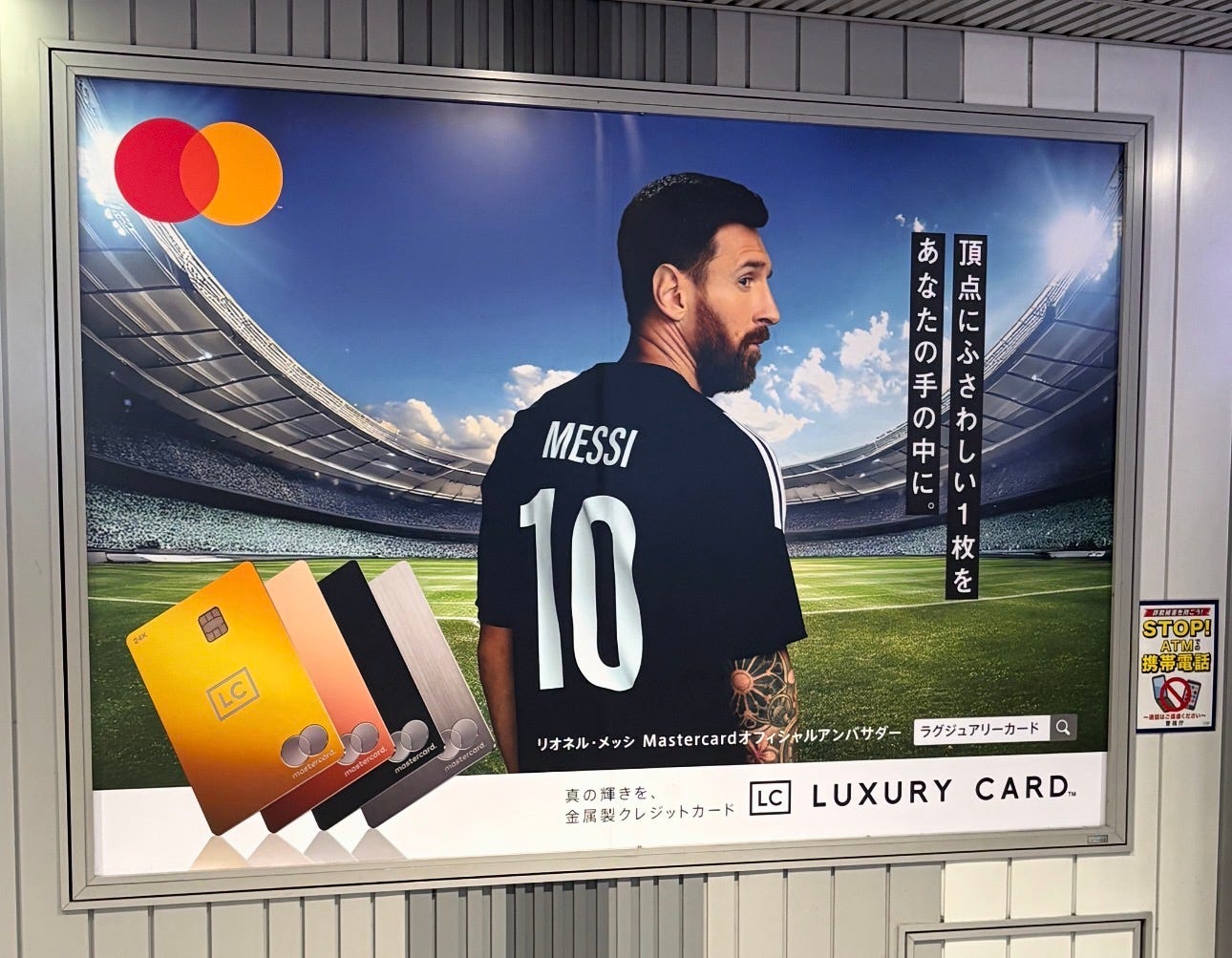
Visa is FIFA’s exclusive payment partner, so there wasn’t the option for Ant to sponsor at the tournament level like they did for the Euros. A key factor when understanding why Ant International decided to sponsor Argentina specifically is Messi, a player whom many consider to be the world’s greatest ever. Lionel Messi has scored eight goals in his five games at the tournament so far,21 and in many parts of the world, especially among younger generations, it’s common for fans to support a specific player as much as a team. When Argentina and Messi play the world stops and watches. Associating with a star player may be as valuable as associating with a team or even the tournament itself.
With GlobalData estimating that sponsoring the tournament could cost upwards of $60 million dollars in each four year World Cup cycle it should be no surprise that many banks and fintechs prefer to sponsor national teams instead. In some cases it may be less about cost, but a desire to focus on a brand’s home market. dLocal sponsors the Uruguayan national team — the company was founded in Montevideo back in 2016, and helps international brands sell compliantly across the world. Uruguay didn’t do so well at this year’s World Cup, exiting in the Group Stage, however dLocal are a strong example of a national payments champion landing a role as an official sponsor of their home country.
In fact, data from FXC Intelligence found that 88% of teams at the World Cup have a banking or payments related sponsor. Although, on a team’s shirt it’s much more likely to be a bank than a non-bank partner, which may reflect the fact that banks are still the ones with the biggest marketing budgets.
dLocal released a video called The Payers to coincide with the start of the World Cup. The video helps highlight both their sponsorship of the Uruguayan national team as well as the global reach of their payment capabilities. Additionally they released A Payers’ Game Guide, which they describe as a payments guide for global businesses to win the World Cup moment in emerging markets.
Four years ago Crypto.com was a full sponsor of the Qatar World Cup and crypto was prominent throughout the event. But this year the only crypto sponsor is Kraken, which is the official crypto exchange of the tournament, a level below full sponsor status. This is a crypto-as-an-industry demotion from 2022 when crypto was far more visible. You can’t pay with crypto at the tournament and the Kraken deal was announced only a few days before the tournament started.
Visa is the official payment partner of FIFA — world football’s governing body, and the organisation in charge of the World Cup tournament. At the Qatar World Cup only Visa cards could be used for payment. This time, payments within stadia are not restricted to Visa. However, the first wave of ticket sales was restricted to Visa cardholders only. Over one million tickets were sold before ticketing was opened up to non-Visa payment methods. That means if you only had a Mastercard or American Express card you would not have been able to participate in the first wave of ticket sales, which started on the 10th September 2025, under the name Visa Presale Draw.
The FIFA partnership is of utmost importance. This can be seen in the legal action that happened when FIFA switched their allegiance from Mastercard to Visa in 2006. Mastercard sued and won a trial in the Southern District of New York.22 The case rested on whether Mastercard had a contractual right of first refusal for the next World Cup cycle. They lost on appeal when the Second Circuit reversed the verdict. Since then, mirroring the general trend towards digital payments throughout the world, the Visa partnership has been a strong lever to gradually transform the World Cup into an almost cashless affair.
I say almost cashless as in some cases a fully cashless experience is not possible due to local laws and regulations. In some US states refusing cash is illegal. One way around this is to provide kiosks that convert cash into prepaid cards for in-stadium purchases. Often these are Visa cards, such as at the Boston stadium — known as Gillette Stadium outside of the tournament.
In Mexico two of the three stadiums hosting World Cup games accept cash, reflecting the fact that cash usage is much more prominent in Mexico23 than in the US or Canada. That said a beer at Mexico City’s Estadio Azteca will set you back over $17.43 on average (around 300 pesos), which is roughly the same as Mexico’s daily minimum wage. Showing a big disconnect between the local economy and in-stadium pricing. While fans are happy to pay big money to attend games it does feel like an own goal to charge so much for a beer when buying a drink in a bar outside the stadium is so much cheaper.
There’s something special about the World Cup.
Before the tournament started I wasn’t at all looking forward to it. For the most part I’d stopped watching football, and hardly watched the English Premier League the past season. Over the past year I was losing interest in football. The big club teams with the most money keep winning — perhaps it was all becoming too predictable.
Yet as soon as the World Cup started I found myself watching several games a day. I found myself falling asleep watching Iran vs New Zealand, which kicked off at 1am local time. Not a game I’d find myself watching outside of the World Cup.
The many sub-plots of the World Cup can make it compelling to follow even if you are not a big football fan. The big name players Haaland, Mbappé, Kane, and Yamal are scoring goals, although not quite as many as Messi. Minnows such as Cape Verde massively outperformed. The Dutch King celebrated with the Curacao team in their changing room after they won their first ever World Cup point, before flying to watch the Netherlands play on the same day in a different city. Every game has a story and each player represents the pride of the nation.
Now with the quarter finals about to begin, every single game looks exciting.
I finalised the original version of this post on a flight from London to Tokyo recently. However, I left my Macbook charger on the flight. Thankfully customer service in Japan is almost always excellent. Before I left Japan I got the charger delivered to my hotel! In what other country would that happen? Speaking from experience, not in the UK. Due to the charger mishap this post got delayed by more than a week but in turn it got longer and a bit meatier. I hope you enjoyed reading it and I hope you enjoy the rest of the World Cup!
Thanks for reading. Feel free to reach out with any feedback, comments, or suggestions. You can contact me on LinkedIn, Twitter (X), via email. Also please get in touch if you’re interested in working together. For instance: advisory work; fintech consulting projects; brand content partnerships; sponsoring this newsletter.
Lastly, next week I am co-hosting London Fintech Drinks. This is an informal meet up to chat all things fintech and payments. I’ll be joined by other Substack writers from Business of Payments, Payments:Unpacked, Fintech: Under the Hood, and Angles on Fintech. If you’re in London, it’d be great to see you there.
I will not call it soccer. Ever.
The Olympics is the only comparable event and given that many Olympians are amateur athletes and the games feature so many different sports over a month, I would say that the exposure is much less intense than a football World Cup.
Once reunified, the German state continued as the Bundesrepublik Deutschland — the Federal Republic of Germany. It was East Germany, officially the Deutsche Demokratische Republik (DDR), that ceased to exist.
The 1974 World Cup had a quirky set-up. It had no knockout rounds. It went from a first group stage, to a second group stage, and then the final. Sixteen teams played the first group stage; the eight that advanced were drawn into two further groups of four, and the winners went straight to the final. East Germany came through the first group but finished bottom of their tough second-round group, which also featured the Netherlands, Brazil and Argentina.
Italia 90 is the first World Cup I can remember watching as a child.
Of course, let’s be realistic, there would have been some East Germans who did not want reunification and were not supporting West Germany at the 1990 World Cup, but they were in the minority.
The West German flag.
Rather than two as had previously been the case.
The seven World Cups from 1998 to 2022 featured 32 teams.
The other two occasions Mexico hosted were in 1970 and 1986.
Canada hosted the 2015 FIFA Women’s World Cup, which was the seventh FIFA Women’s World Cup.
Population estimates are from UN World Population Prospects.
Nigeria lost the African playoff game to the DR Congo.
The favourites are once again France and Argentina. That said, England will keep dreaming of repeating the exploits of 1966.
It was quite the journey from Indonesia to Europe just to play one game at the World Cup, a journey which took weeks by boat back then.
Of course smaller countries will often see many of their players go abroad for better opportunities. But having a structure at home seems to be of key importance too. Take Croatia for example, nearly all of their successful international players started their careers in either Dynamo Zagreb or Hajduk Split, before usually moving on to bigger teams.
As a counterpoint to big countries seeking success on the international footballing stage, countries such as Uruguay and Croatia have performed well in international tournaments over the years — despite both countries having populations of less than four million. Highlighting that bigger is not always better when it comes to footballing success.
The only significant local payment system is HUMO.
Discussed in depth by CGTN in Beyond the logo: How China is moving up the World Cup value chain.
The UEFA European Football Championship, like the FIFA World Cup, takes place every four years. The Euros, as they are commonly known, take place in the gap between the World Cup cycles.
Messi has scored 21 World Cup goals in total at the time of writing. Prior to this tournament he was on 13 World Cup goals and was three behind Miroslav Klose’s record tally of 16 goals, which he has now overtaken seemingly with ease, and he may yet go further in the game(s) to come.
The trial ruling was MasterCard Int’l Inc. v. FIFA, 464 F. Supp. 2d 246 (Southern District of New York, 2006); it was reversed on appeal at 471 F.3d 377 (Second Circuit, 2006).
A recent survey found that for purchases of 500 pesos or less, 85% of adults used cash as their payment method; for larger amounts it was 73%. Data taken from a financial inclusion report — in Spanish, it’s known as ENIF, Encuesta Nacional de Inclusión Financiera.