



Welcome to Payments Culture!
This newsletter explores how money moves, across borders and cultures, and how it’s changing.
After a short break it’s great to be writing again on Substack. Between now and the end of the year there’s lots of — hopefully interesting — content on the way.
Any comments or feedback are welcome. Feel free to leave a comment at the bottom of this post, or you can reach me directly via LinkedIn, Twitter (X), or email.
This week’s post is in collaboration with Arlen Agiliga, who writes the Substack The Economy, Stupid. His writing has been featured in publications such as The Diplomat, and his career experience includes working in investment banking in both New York and in Ulaanbaatar, Mongolia.

I start with a brief Q&A with Arlen, before his essay, which looks at consumption, credit and securitisation. It asks whether financial innovation is helping Americans afford more, or enabling them to consume beyond what they can really afford — something relevant in a world of fintech where credit is partly moving from cards to the point of sale.
Can you briefly introduce yourself and give an overview of what you usually write about on your Substack?
I’m Arlen, the creator of The economy, stupid., which is my Substack column where I write broadly on deals, global business and current affairs. The essay I wrote for Payments Culture has a deals and business focus, as it identifies a growing securitisation trend in American capital markets. I drew heavily on my experiences as a former financial institutions investment banker while writing ‘Everything for Sale (on Credit)’, and I dive into innovative financial products and the structure of capital markets in a few other essays on my Substack as well:
in ‘What Britney, Fannie, and Freddie All Have in Common’, I discuss the conservatorships of Fannie Mae and Freddie Mac and the politicisation of American housing markets;
in ‘When Capital Markets and Mother Nature Collide’, I discuss the growing market for catastrophe or ‘cat’ bonds and insurance-linked securities;
and in ‘The Quiet Rise of UnionPay’, I chart the development of UnionPay, China’s state-owned payments firm and the operator of the world’s largest card network, and discuss the role of industrial policy in services businesses.
In addition to starting my career as a financial institutions group (FIG) investment banker, I have also worked as a generalist investment banker at international boutiques and as an associate at a frontier and emerging markets private equity firm.
Having worked in both Asia and the West, what are some of the key differences you’ve noticed in how consumers approach credit? And some examples of this.
Looking at macroeconomic data is helpful here. Take America, China and Japan as examples just to illustrate the point. America, China and Japan all have relatively high levels of household debt (they have high household debt-to-GDP ratios). But in addition to high household debt, both China and Japan have incredibly high household savings rates, whereas America’s household savings rates are rather low.
The difference in savings rates despite high debt levels across each economy is not just because Asian people culturally like to save more (although that could be part of it). The difference is also driven by the diversity of financial products and types of credit available to consumers in each economy, which comes back to the point I make in ‘Everything for Sale (on Credit)’: the American economy has been engineered to make consumption frictionless, whereas many Asian economies have not.
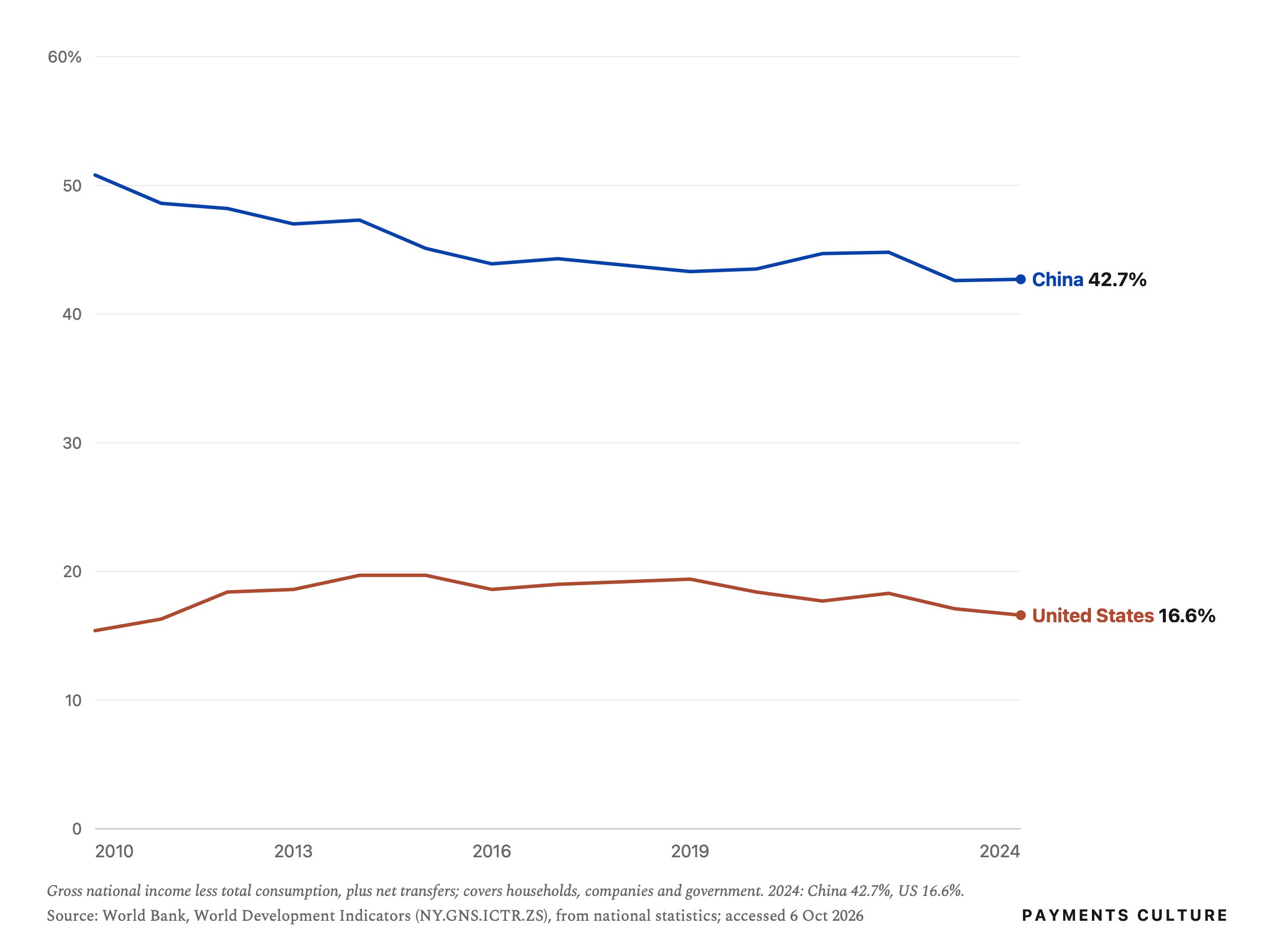
Flexible consumer financing is an instrumental part of the frictionlessness of American consumption, and the lower savings rate in America relative to Japan and China despite comparable levels of debt is enabled by American households’ ability to more readily convert their assets to cash, due to America’s diversity of consumer finance products and deep capital markets.
So whereas American consumers tend to use accumulated income to purchase assets and then finance those assets to fund further consumption, Asian consumers tend to lock up their income in savings as they accumulate more assets and become wealthier. This makes Asian consumption more elastic than American consumption (in the short-to-medium term). I think that’s the fundamental difference in how consumers approach credit across Asia and the West. Of course, there are so many country-specific caveats that this question is impossible to answer succinctly, but hopefully my answer gives you insight into how I think about these things.
It seems that these days with BNPL and other fintech products offer the opportunity for consumers to garner credit instantly at the point of sale — as opposed to in advance, eg with a credit card. Is this something that should concern us? Or can it be a positive for consumers?
I think it can be a positive for consumers if they engage prudently with point-of-sale or instant credit, but I also think the burden of estimating creditworthiness should fall on the firms doing the lending, since they are incentivised to ensure that their borrowers can actually repay the loans for which they are approved. The average American consumer will always be happy to receive a new line of credit, but if the lending firm cannot accurately gauge the borrower's ability to repay, then their lending model is flawed. And given the nature of the lending, firms engaged in BNPL, point-of-sale and instant lending should really be the best at gauging creditworthiness, since their businesses depend on making accurate decisions quickly.
Was there any particular moment when you noticed what you call “the securitisation of everything”?
The impetus for the idea came from a headline I saw that said Apple planned to lease iPhones for $17.99 a month through a partnership with Klarna. Product leases are a textbook securitisation strategy for high-volume, high-value retailers like Apple, and it was in that moment that I realised this was an idea worth writing about. I have also seen the BNPL taco memes in various places across the internet, but the Apple–Klarna headline helped me form a deeper idea related to the same sentiment.
How to you see consumer credit developing in the next decade? If BNPL was the key innovation of the past decade, what do you think we’ll see in the next?
I think credit will become even more widely available, and that alternative data will play a bigger role in assessing creditworthiness, with credit scores giving way to more granular measures of a borrower's ability to pay. AI, blockchains and other emerging technologies (like agentic finance) will all help drive these changes, which aim to make consumption stickier and more consistent from period to period.
Thanks Arlen!

Everything for sale (on credit)
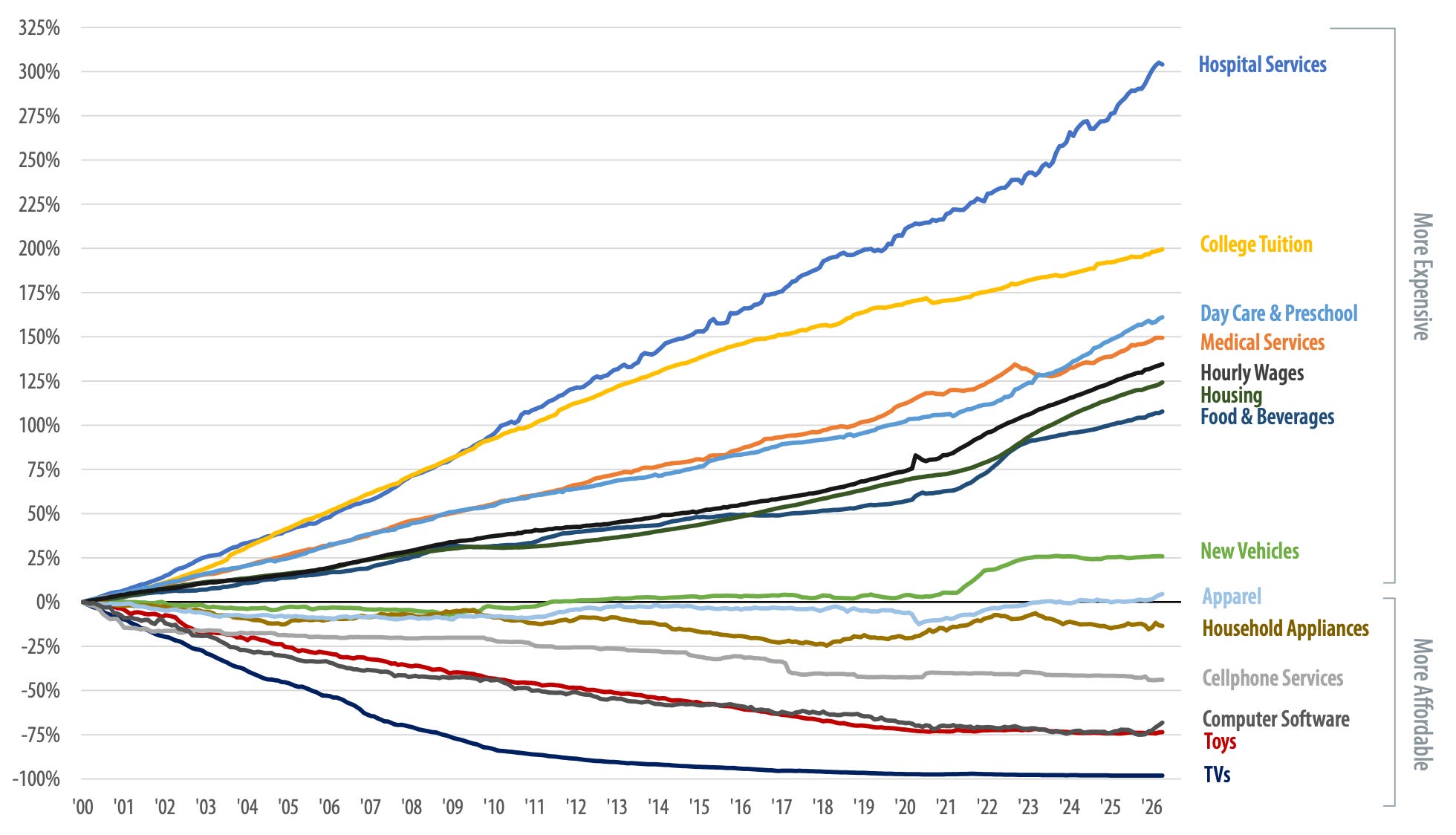
The affordability crisis is arguably the most popular gripe amongst Millennial and Gen-Z Americans. Everything from housing to food feels more expensive, and inflation is too high. Not only are things more expensive, but the feeling that there are simply more things to buy these days, compared to previous generations, is also directionally true. New York Fed researchers Christian Broda and David Weinstein found that the number of imported product varieties increased roughly fourfold between 1972 and 2001.
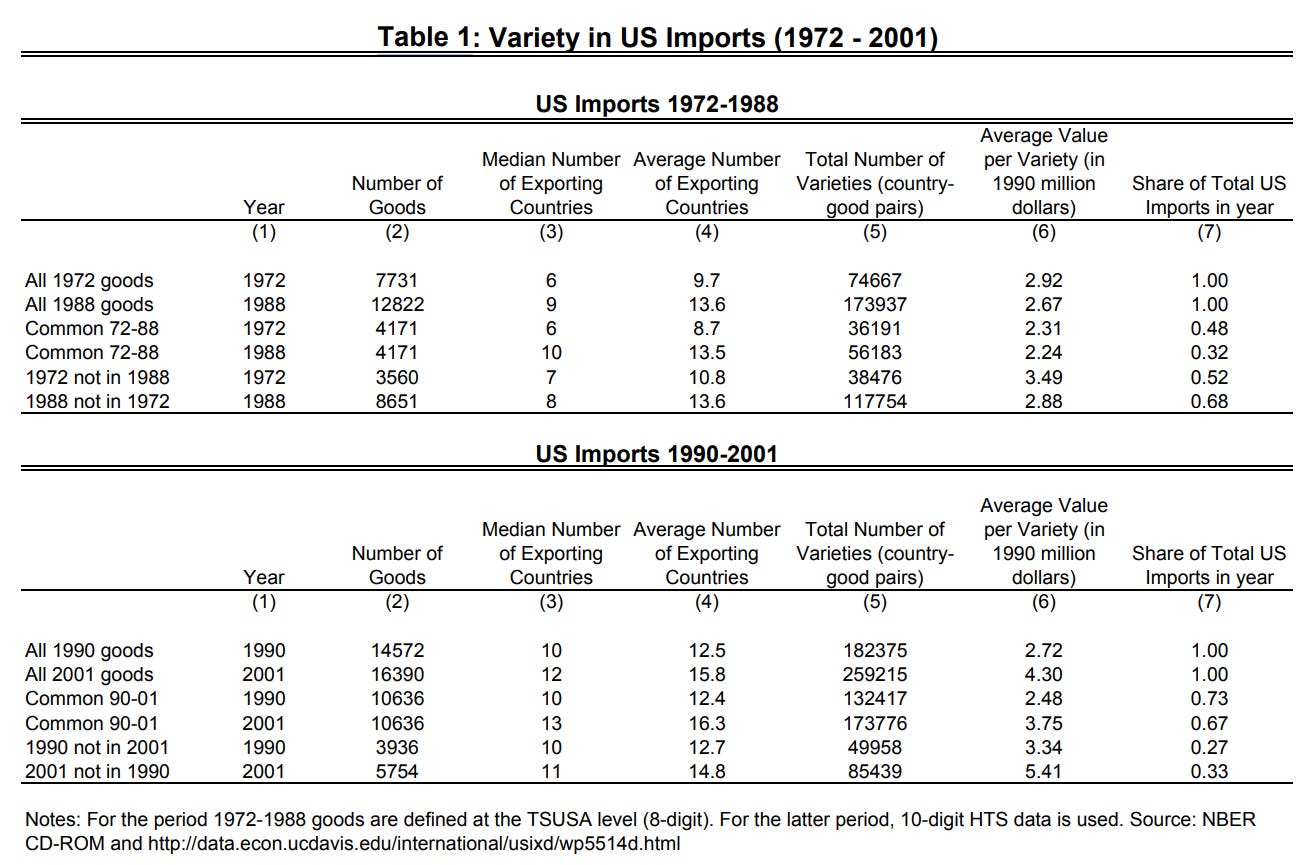
One would imagine that the affordability crisis has negatively impacted demand, but paradoxically, American consumption is as strong today as it has ever been, remaining resilient through the pandemic as well as inflation and oil shocks, underscored by recent strong retail sales data. Despite higher prices, more things to buy, and an uncharacteristically pessimistic outlook (see in this consumer sentiment date), Americans counterintuitively continue to do the one thing that they do best: consume.
Understanding the seemingly intentional decision by American consumers to consume in the face of persistently high inflation and a pessimistic view of the future is difficult, but part of the calculus is a lag between the act of consuming and the pain of payment.
The pain of consumption is only truly felt when cash leaves one’s checking account. If a consumer has access to debt, they can consume without pain for a time period before worrying about the future. For this reason, the ubiquitous role of consumer credit in the American economy must be acknowledged as a critical supporting factor t in the face of formidable consumer headwinds.
Bank of America CEO, Brian Moynihan, recently challenged the largely prevailing negative view on record consumer credit card balances, saying that higher consumer credit balances are in line with the overall growth of the economy. In a consumption-driven economy like America’s, the chicken-and-egg relationship between credit growth and GDP becomes difficult to unpack — is credit growth driving GDP, or is GDP driving credit growth?
When GDP is really driving the growth in credit available, this is generally a good thing. But problems arise when credit growth drives GDP because credit growth is not always tied to the underlying economy, and may not be grounded in underlying economic reality.
Credit growth can be manufactured — alchemised out of thin air. Take 2008, for example, when increasingly unsecured credit securities were stacked one on top of another until entire credit agreements collapsed. assets underlying them could never support the growing heaps of credit foisted upon them. The 2008 example is illustrative because it demonstrates both the ingenuity of America’s financial markets and their tendency for excess and moral hazard. Who will bear the consequences if it all goes wrong?
Mortgage-backed securities (MBS) were instrumental in popularising the fixed-rate 30-year mortgage that made home ownership a possibility for large swathes of America. By making investments in mortgage loan portfolios widely available to institutional investors, the MBS facilitated increased mortgage access and affordability. But in 2008 and the preceding years, the MBS was employed to finance increasingly risky home purchases for overextended consumers. Something that drove the eventual housing collapse.
2008 was driven by the abuse of an otherwise incredibly convenient and consumer-friendly financial product. But that such a financial product existed at all — and that institutional bad actors had the latitude to abuse it — are testaments to the power of the double-edged sword that is one of American capitalism’s most defining features: deep, broad, and flexible capital markets.
As the American economy has evolved in terms of both price and product dimensions, its formidable capital markets have evolved alongside it. The idea underlying the MBS product — namely that the holder of a set of promised cash flows can package and sell those cash flows to third parties — has been applied to large purchases other than just homes. Indeed, as bigger-ticket purchases have become more common, large and thriving markets now exist for repackaged automobile loans, residential solar loans, electric personal mobility device loans, buy-now-pay-later (BNPL) transaction loans, and even cellphone upgrade payment plan loans. These MBS-like products are generally referred to as ‘asset-backed securities (ABS).’
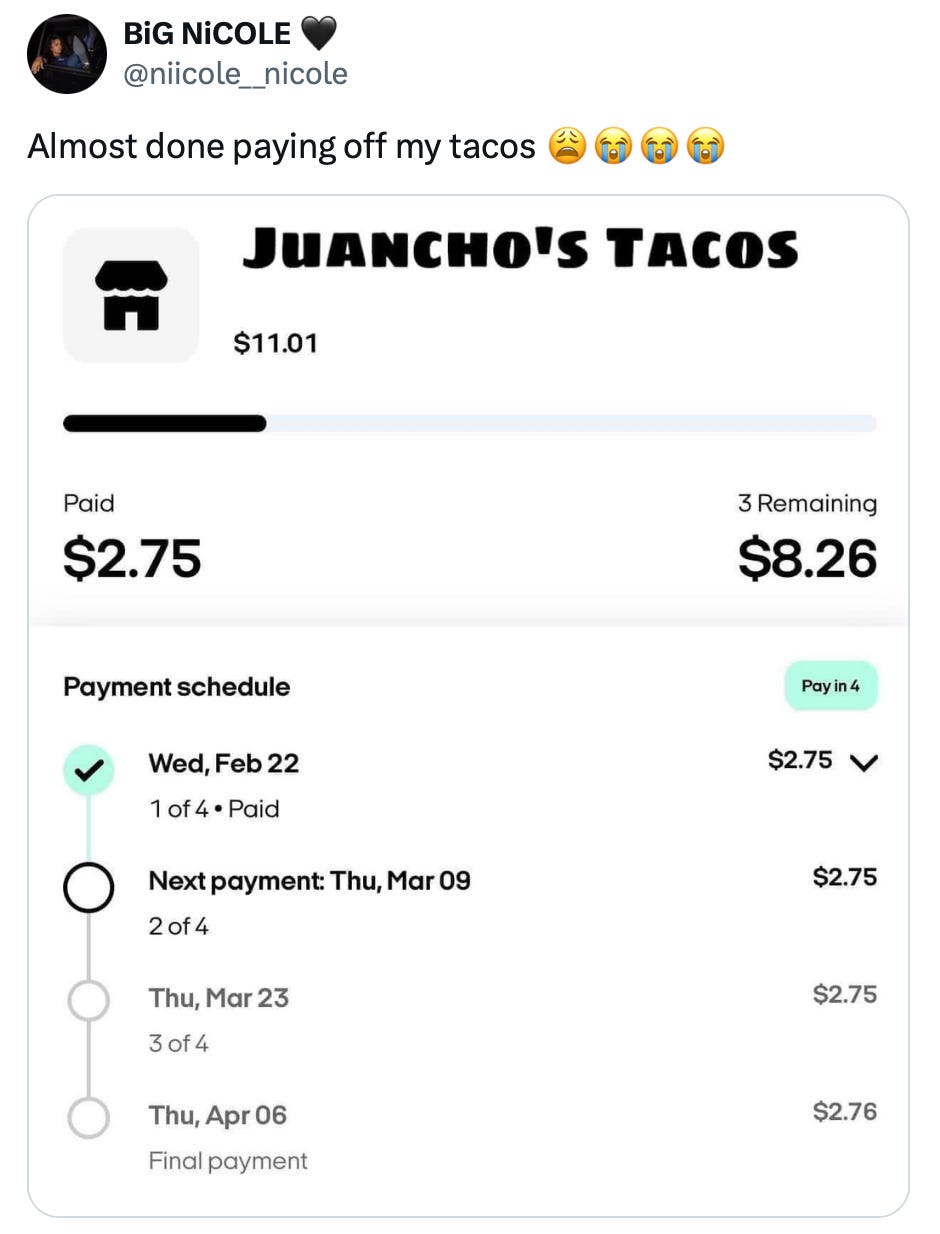
Taken to its logical extreme, the ABS idea can be applied to even the most minuscule of purchases. But relative to a consumer’s income, these purchases may still be worth financing. For example, screenshots of BNPL transactions for purchases as trivial as an order of tacos have become popular memes. This is both a criticism of the model and an acknowledgement that the only reason a consumer would choose to finance a purchase of tacos with BNPL is that it’s economically optimal to do so.
Just like MBS for the housing market, growth in the ‘consumption market’ is facilitated by ABS for purchases as granular as BNPL-financed tacos. And again, in a consumption-driven economy like America’s, this is a valuable and important thing. It’s critical to assess whether consumers taking advantage of BNPL transactions are overextending or are they optimising?
Note: For the sake of specificity, the credit underlying BNPL ABS is technically unsecured credit, like a credit card. This is different from ABS, consisting of secured loans like MBS and some of the other ABS markets mentioned, like auto loans or residential solar. But in the example of the BNPL-financed tacos, the lender still reasonably assumes that the borrower is employed gainfully enough to fund the BNPL transaction with their next paycheck. As with all credit, whatever the amount, there’s a lag in timing between the pleasure of consumption and the pain of payment.
Links, news, and views
Taking a look at a few other stories that have caught my eye
A couple of weeks back fintech was awash with the news that Brazil’s Nubank was in talks to buy Monzo, in a deal worth up to £10bn. Last week Nubank made it clear that it was not pursuing the acquisition, and in the past few days, the FT reported that Monzo is in discussions with two private equity firms, CVC and Advent International, regarding the potential sale of up to 15% of the company.
My reading is that Monzo is at an inflection point. Revolut’s growth in the past 5-6 years has left Monzo behind and now it is looking to take action in a much bigger way than before.
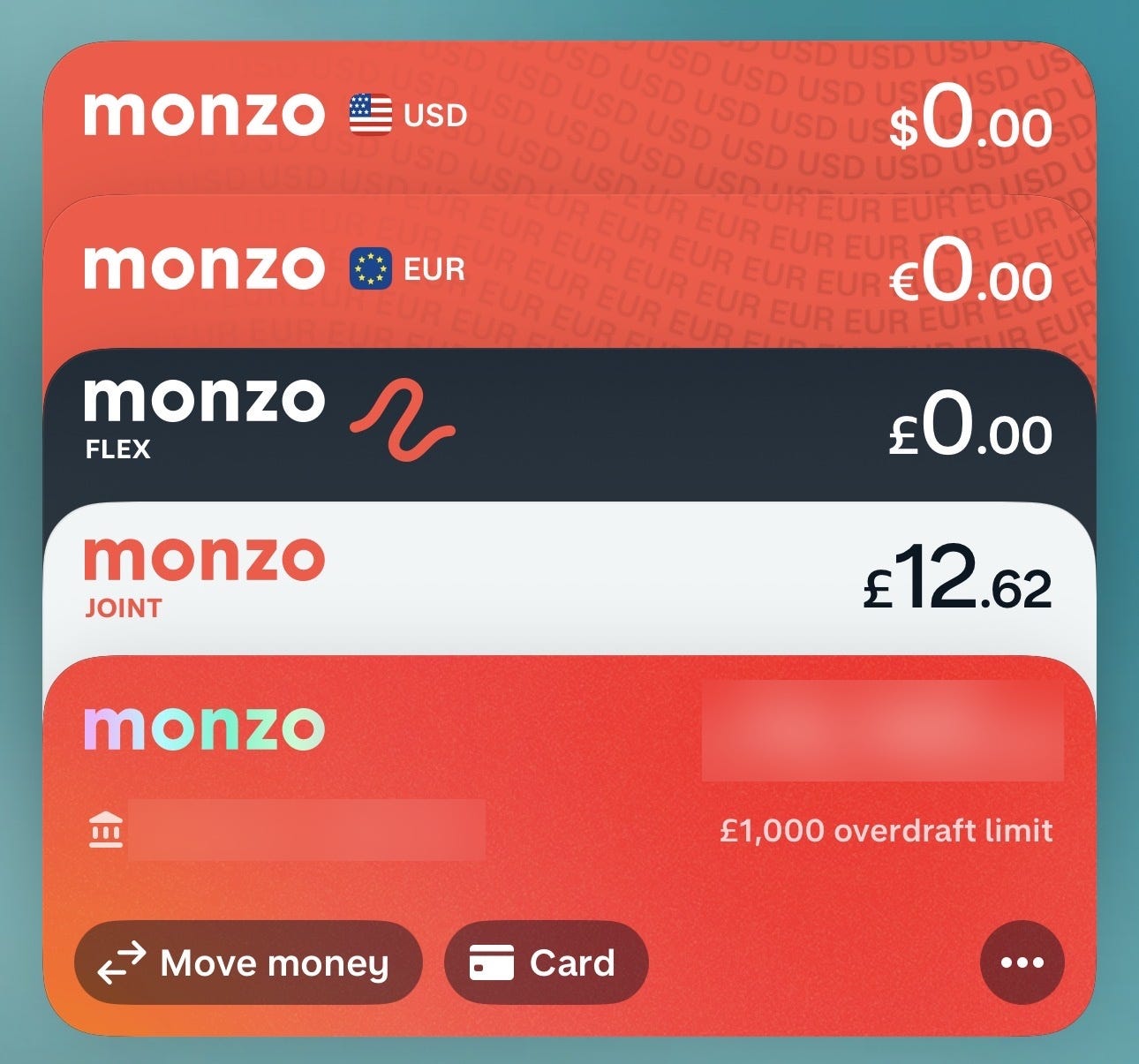
The UK’s two largest neobanks had similar valuations until early 2020, and since that point Revolut’s valuation has skyrocketed, while Monzo’s has grown albeit at a much steadier pace. Today Revolut’s valuation is 9-10x that of Monzo. If Revolut didn’t exist, Monzo would be seen as a huge success story, but when compared to Revolut it’s easy to think of Monzo — perhaps unfairly — as a missed opportunity. Monzo launched in Ireland earlier this year with Spain to follow soon. I predict we’ll see more new market announcements from Monzo in the months ahead and a widening of the product set. Today I was able to open multi-currency accounts in my Monzo app.
As I write this paragraph Instinct is finding me a new home insurance policy. What does that mean? Well, Instinct is a company that’s hard to describe. It’s not an app. It barely has a website (its website is a single page). It operates via a WhatsApp or iMessage chat and it describes itself as a personal assistant, and others sometimes refer to it as a personal agent. It may initially feel like talking to ChatGPT via a messenger app. But after a while, after using Instinct for several tasks, you can see this is something quite different. It can grab you a restaurant reservation, do your online grocery shopping, or find you a new outfit for the weekend.
Meta’s Muse is an Instinct competitor and has had great reviews, but this is US and Canada only so far. ChatGPT launched dots, but this is only for those with a $200-a-month ChatGPT account. Instinct has a head start, yet can a startup go up against big tech companies valued in the trillions of dollars?
The above video is from this week and is an interesting mainstream tech discussion and comparison of the various competing AI agents. Both the good and the bad. The most notable thing is how fast this space is moving.
Getting back to Instinct. Impressively the company was valued at $10bn in a recent investment round — not bad for a one-year-old company. Noah Shinn is Instinct’s founder, and is only 23 years old. Check out the interview below with Noah on the Invest Like the Best podcast. Lots of fascinating insights on his journey so far and discussion of how personal agents and agentic commerce intersect. I’ll be looking into this topic in more detail on this Substack soon.
On this Substack I’ve written a couple of times regarding Meta’s foray into VR. Likely near the top of the metaverse hype I wrote in Meta’s payments potential about how Meta was missing a trick by not building Meta Pay into an Apple Pay equivalent, especially given its strength in software, and, in a nascent sense, hardware too. Although no specific Apple Pay revenue number gets published, Apple Pay has been estimated at circa 1% of Apple’s revenue, which would equate to $4-5bn. Given Meta’s reliance on ad sales, payments would offer an opportunity to diversify revenue and build a connected wallet ecosystem across software and hardware.
While VR as a category has struggled, Meta’s Ray-Ban partnership has proved popular. Meta is in this for the long haul, having invested in Ray-Ban’s parent company EssilorLuxottica last year. The glasses have caused controversy given the ability to record others with relative anonymity. But there does seem to be a convergence underway. Last year I noted how Chinese companies were fast advancing with AR glasses tech. It felt like Meta was slipping behind, yet recently Meta showcased VR glasses which do seem genuinely impressive.
Glasses are one of the few things that many people carry with them everywhere they go, every day. Therefore it makes sense for glasses to eventually take on some of the features that we use our phones for today. But in the short term Meta sees the payments opportunity not in VR headsets (the market is too small and there’s still a lot to figure out), but rather in building Meta Pay for its personal agent solution, Muse. This is something worth watching.


Lastly, something totally unrelated to fintech that I enjoyed reading in the past days was Kristian Niemietz’s analysis of German beer festivals outside of the well-known Oktoberfest.
Thanks for reading! Have a great week and feel free to reach out with any comments or feedback.
Please consider sharing this newsletter with a friend or colleague if you enjoyed reading this edition. If you are not yet a subscriber please sign up below for a free or paid subscription.
Note that views expressed on this Substack are my own and do not represent any other organisation. Also nothing I say should be taken as investment advice.
Great post on the securitisation of everything! America in particular seem to enjoy this, I've seen it from car loans to consumer credit (both of which you mention) and now... food payments?