


Welcome to Payments Culture!
This newsletter explores how money moves, across borders and cultures, and how it's changing.

This post is a follow-up to something I wrote earlier this year titled How Geopolitics Shapes Fintech in 2026. It's worth reading the earlier post before this one if possible but not essential.
In that post I set up the idea that fintech and geopolitics intersect far more than many people think. This is a good time to highlight how everything comes together in the context of an ongoing event. After setting the scene we get into topics such as cloud and data centre infrastructure, crypto and stablecoins, and how today’s wars are fought as much in the digital world as the physical one. As ever please let me know any feedback via LinkedIn, Twitter (X), or email.

On the 18th of June 1815 the Battle of Waterloo took place in what is now Belgium.

On one side was Arthur Wellesley, the Duke of Wellington, who commanded the Anglo-Allied army. On the other side was Napoleon Bonaparte — the French Emperor — and his men. The battle was won by the English and their allies. A battle which became so famous that even ABBA wrote a song about it, and it won the Eurovision Song Contest in 1974. Four days after the battle Napoleon abdicated and was exiled by the British to St Helena, an island in the South Atlantic, where he remained until his death some years later.
During the battle one of Wellington’s men caught sight of Napoleon within range.
“There’s Buonaparte, Sir. I think I can reach him, may I fire?”
Wellington responded:
“No, no. Generals commanding armies have something else to do than to shoot at one another.”1
The source of this event is Wellington’s biographer, and the anecdote tells us something interesting about the views of the time. Taking out an opposing general directly, in what is known today as a decapitation strike, was not considered gentlemanly. Generals sought to win on the battlefield through skill and strategy, and any potential shortcut to victory was neither sought nor desired.
History has other similar stories.
Back in the 12th century, during the Third Crusade, Richard the Lionheart was sick with fever. In a sign of mutual respect his arch enemy Saladin sent him fruit and his personal doctor to help take care of him.2 The two never met in person, although their respective forces fought across the Holy Land for two years. War has always meant death, destruction and suffering, but war had an honour code.
Unlike the examples above, the de facto playbook of modern warfare is different. The previous unwritten rule that meant not going after the opposing general, emperor or leadership is over. On the 28th of February 2026, the US and Israel unleashed a maelstrom of destruction on Iran, and Iran’s leader, Ayatollah Khamenei, was bombed and killed in the opening salvo.
Anusar Farooqui, who writes as PolicyTensor on X, argued on a podcast with Jeet Heer of The Nation that there is no precedent for such action in modern Western history.3 Leader decapitation did not exist as a strategy until very recently. Yet, despite the gambit, taking out the Iranian leadership did not work.
After roughly six weeks of fighting there was a ceasefire, which expired and was replaced by a Memorandum of Understanding.4 This opened the door to potential changes in how Iran’s financial system interacted with the world:
Releasing some of the estimated $100bn in frozen Iranian assets by removing US secondary sanctions, without which banks cannot easily send money to Iran.
Immediate easing of oil-related sanctions allowing Iranian crude oil to enter global markets for the first time since 2018.
Helping ease Iran back into the global financial system. Meaning the lessening of the use of local crypto exchanges as a workaround to sanctions. Especially interesting as the US Treasury sanctioned Iranian crypto exchanges Nobitex, Wallex, Bitpin, Ramzinex and associated personnel in early June, two weeks before the MoU was signed, which was potentially part of the negotiation.
But regardless of the promise of the MoU, in the past two weeks hostilities restarted.
Tit-for-tat accusations erupted in more sustained attacks. As I write this the US has paused its attacks on Iran after thirteen straight nights of strikes on the country. Alarmingly for the global economy, last week the oil price hit $100 a barrel for the first time since early May.
There was a fear that during the World Cup the war would start again and take away from the tournament. But it did restart somewhat under the radar, at a lower velocity than before, and it hasn’t dominated our TV screens like it once did. The consensus among analysts is that neither side wants a return to full-blown war. At the same time the status quo doesn’t suit either side. How exactly things will pan out is not clear. Although we can say that this war has been yet another rupture in the global order. The implications for how money moves are under-explored.
From Gold to Digital Dollars
I wrote in a previous post that fintech doesn’t exist in a vacuum. In that post I covered topics such as financial chokepoints, how markets reacted to the US raid on Venezuela (signalling new potential opportunities for e-commerce platforms), and how stablecoins have the capacity to help state actors avoid sanctions.
A core part of the analysis centred on the fact that our fintech lens often sits at the level of technological change, funding rounds, and big personalities, but rarely covers the main societal and political shifts taking place — including war.

In previous eras money moved differently. In some cases it was a matter of stealing a nation’s gold — as the Nazis did in World War 2. Bankers rushed to send their gold reserves to the US and Canada to escape the tentacles of the Third Reich. The Bank of England successfully sent 2,000 tons of gold from the UK’s vaults to North America and helped other European countries do the same. Despite this, estimates are that Hitler’s men plundered a value equivalent of $20bn in today’s money from central banks in Europe.5
Another example of how war and gold come together can be seen from 1797-1821. During the Napoleonic Wars, Britain moved away from the gold standard. There was a risk of a currency crisis as sightings of the French fleet off the coast of England led to panic as farmers sought to change their pounds into gold:
The Newcastle banks were first to run out of reserves after local farmers, on 18 February 1797, had sold their cattle cheaply and had gone, almost in one body, to their local banks to cash the notes they had received.6
War spending drained the nation’s gold reserves. Allowing pounds to convert to gold 1:1 could have bankrupted the Bank of England, something which doesn’t make sense in today’s world where central banks can print money7 for reasons of financial stability, yet back then there was cause for concern. The usual mechanism of swapping pounds for gold at will was put on hold.
Physical gold was for centuries the main medium of monetary exchange. Gold bars and gold coins were money both within and between nations. Today is different. Money can zip across borders in seconds. In wartime data centres routing digital dollars can get disrupted by drones and missiles. If power goes down then money doesn’t flow. Every impact to critical infrastructure is a blow to financial flows, and the systems that power the global economy are more brittle than they may seem.
Fintech needs the cloud
It’s no coincidence that fintech hit its stride when cloud service offerings started appearing as standard. What is the cloud? It’s another name for running software and storing data on shared infrastructure in a specialised location. Cloud providers can host many companies under one roof, eliminating the need for fintechs to have infrastructure on their own site — helpful given that startups may operate from a co-working space or even a bedroom in the early days.
These days we don’t even think about whether we need a data centre or not, we just choose which of the main providers we want to use. Usually this means AWS (Amazon), or Azure (Microsoft), or Google Cloud. In earlier times, one of the clearest differences between banks and fintechs was their infrastructure model.

Banks have traditionally operated their data centres locally, often referred to as “on prem”, meaning on the bank’s physical premises. Many banks still operate in this way. Moving to the cloud can be seen as risky. It means less absolute control and working within processes and technical specifications defined by the cloud provider. Legacy banks developed with their core systems and architecture running on site. Neobanks such as Monzo and Revolut developed as cloud-first from day one, and have multiple cloud providers in place so they can switch between providers should an outage occur.
If the strength of working in the cloud is the ability to operate with lower costs and innovate faster, the Iran war has shown that there are also vulnerabilities.
The tech industry often talks about “the cloud” as though it were something abstract and untouchable. But the cloud runs on data centers, those data centers have an address, and that address can be hit by a drone.
Fortune’s AI editor Jeremy Kahn writing in March 2026
In early March Iranian drones struck AWS (Amazon Web Services) data centres in the UAE and Bahrain. Three facilities were hit in what Mahmoud Abuwasel from law firm Wasel & Wasel described as the first publicly confirmed military attack on a hyperscale cloud provider.8
Some fintech companies including Alaan, Hubpay, and ride-hailing app Careem saw lengthy outages. ADCB, one of the region’s largest banks, went offline for two full days (although it was not confirmed if this was specifically related to the drone strike). Regional backup sites didn’t work as intended.9 One of the main promises of the cloud, the promise of switching between data centres within a region to ensure uptime and stability didn’t work. If multiple sites get attacked then this premise doesn’t easily hold up.
This brings us to a wider point. Physical infrastructure vulnerability matters more than ever. In 2025 Trump signed a number of deals with Gulf countries worth roughly two trillion dollars. Yet if the infrastructure is not safe from drone attacks then the investment is much riskier. Emphasising this point, Iran has threatened to attack one of the key projects in the region, the OpenAI Stargate data centre. There’s too much money on the table for these deals to roll back. But operational risk has increased, and companies will have to adapt accordingly.
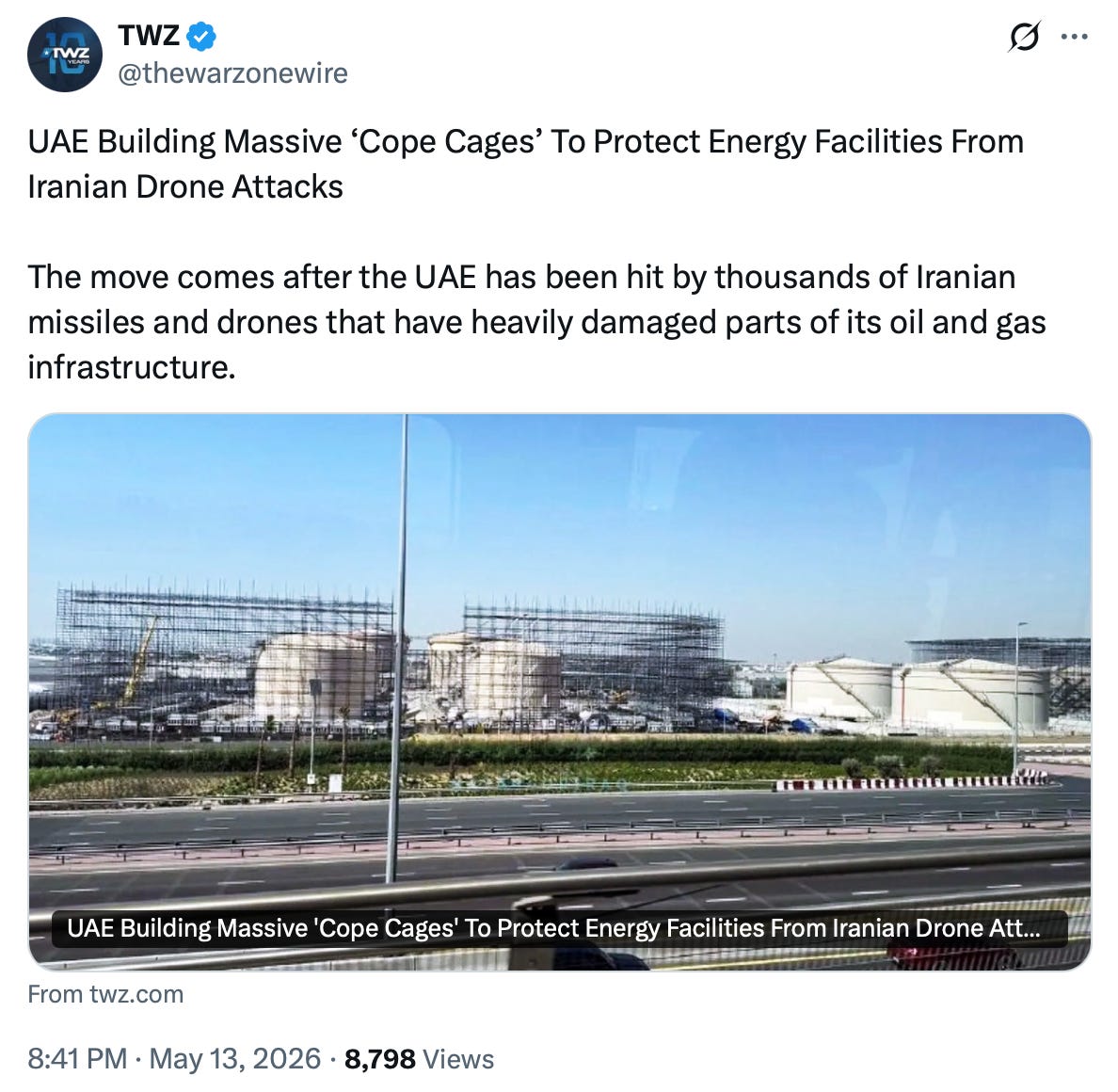
The below image shows oil infrastructure getting physical protection to help against drone attacks. This is a new reality. In a world of AI, data centres are more important than ever and physical protection for key sites could be the norm in areas where the security situation requires it.
From a fintech lens there’s also a regulatory dimension to consider.
Some countries have specific data residency requirements — data must be hosted and stored in-country. In other cases, in-region will suffice. These rules and regulations differ country-by-country, but as a general rule it makes sense for all fintechs to understand options for switching: not just between cloud providers; but also options for switching between regions. Countries should also consider increasing optionality; some markets have fewer cloud providers than others, and regulations may restrict the operating models available to fintechs. The key question is whether you can switch region or provider in the worst-case scenarios.
Iran’s Bank Sepah provides another example of how physical infrastructure forms part of the modern battlefield. The bank is a result of the merger of five banks associated with the IRGC (Islamic Revolutionary Guard Corps). As well as acting as Iran’s premier military force, the IRGC also controls much of the economy, with some estimating that the organisation controls 25-40% of the Iranian economy through formal and informal means. Bank Sepah was responsible for paying IRGC salaries and on the 11th of March, well into the second week of the war, a missile destroyed a Bank Sepah data centre in Tehran.

Bank Sepah wasn’t operating on shared infrastructure. The data centre was only for the bank itself. It was single-tenant infrastructure like that used by many legacy banks in the West, and while there was heavy security on the ground this didn’t help — there was no expectation of a missile attack. Following the hit on Bank Sepah, American Banker reported that there was a heightened threat of cyber attacks to American banks. Banks on the other side of the world can get pulled into a conflict as it escalates from the physical to the digital domain.
Financial infrastructure within Iran remained a target even during the recent ceasefire. While the missiles stopped, banks suffered cyber attacks. Four banks were affected by outages on the 10th of June. On the 23rd of June card transactions failed, and several banks saw ATMs and Point of Sale (POS) systems go down.10 Even though the war had paused, customers still had to deal with disruptions to their finances.
Struggles on the blockchain
In How Geopolitics Shapes Fintech in 2026 I wrote:
Without US-controlled chokepoints, sanctioned states have found ways to move value and [to] garner digital dollars. Analytics firm Elliptic recently identified that Iran has acquired at least half a billion dollars of stablecoins, and this may be the tip of the iceberg — Iranian crypto exchange Nobitex allows users to store USDT.
USDT is issued by Tether, and the stablecoin issuer has worked closely with the US authorities in recent years. Although this cooperation didn’t always come easily. Tether is based in El Salvador and action usually comes only after a wallet or person has been sanctioned by OFAC (the Office of Foreign Assets Control), which is the agency of the US Treasury that enforces economic sanctions. This policy of cooperation with US authorities began only in December 2023, and the volume of illicit USDT is estimated to be far higher than any actions undertaken to stop the flow.
Tether can blacklist a wallet address, making it then impossible to move the assets to another party. Once a wallet is sanctioned the assets are, at least in theory, useless. In April and July 2026 around $475m of Iranian-linked USDT was frozen, which begs the question: if Tether has the ability to render wallets useless, why is USDT still accumulated and used by Iran and other sanctioned states?
Everyone wants dollars. Oil and global commodities are generally priced in dollars. Even though Iran sits outside the formal US dollar system, allies and suppliers are still likely to prefer to receive payments in USD-denominated assets.
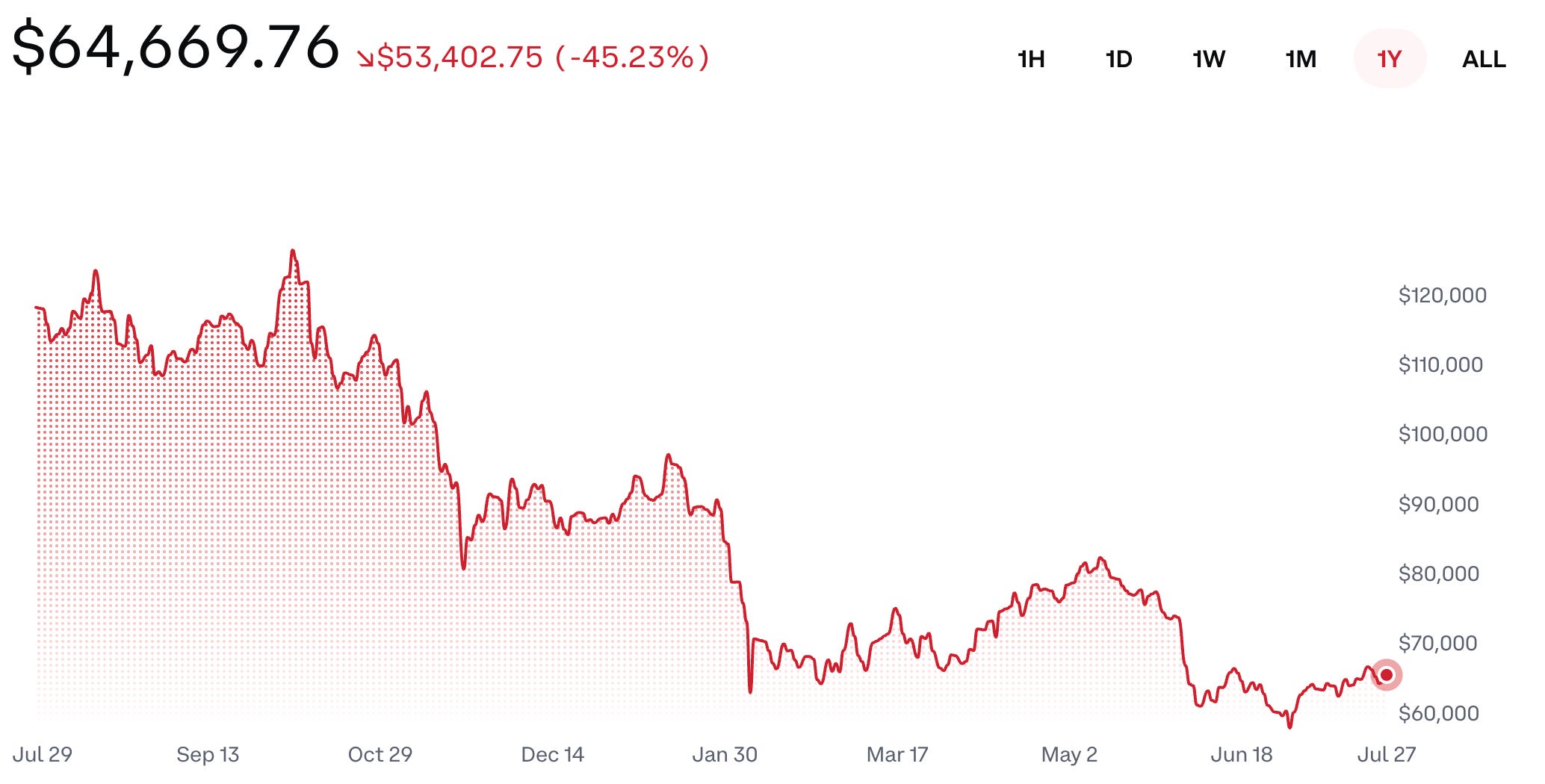
Converting assets held within Iran from USDT to Bitcoin would stop Tether’s ability to freeze regime-linked wallets. Bitcoin is fully decentralised with no issuer, but Bitcoin is down 45.23% in the past year — making it much less attractive as a store of value.11 However the bigger plus for USDT over Bitcoin is the relative lack of volatility.
According to the IMF, the local currency, the Iranian Rial (IRR), is experiencing an inflation rate of 68.9%. Euronews reported that “the official minimum monthly wage for the current year was set at 166.255 million rials (approximately €85)”, which is well below the actual cost of living. It’s not working-class Iranians buying USDT, but anyone with savings to protect. Iran’s leading crypto exchange, Nobitex,12 claims 11 million users, not an insignificant number in a country of 88m people.
Getting wallets frozen may be less bad than it seems. Considering the overall economy, losing some USDT wallets (assuming there are others that have not yet been located), may be acceptable given the alternatives. The Iranian crypto ecosystem was valued at $7.78bn in 2025 by Chainalysis, and we can assume it’s continued to grow in 2026 — getting $475m frozen is part of the price to pay for a regime doing everything it can to prop up its economy.
Paying the price
Another impact that the war has on fintech in the region, but also with global implications, is dealing with escalating levels of sanctions.
When onboarding customers, and performing regular reviews, companies need to ensure that they are not providing services to sanctioned individuals and entities. I saw this first hand a few years back when working for a payments company providing solutions to clients in the Middle East region. Often new names would appear on the US sanctions list matching the name of a director of an existing client. This would require contacting the client and getting additional information and reconfirming ID documentation. In every case I dealt with the end result was no issue. The client had a common name which matched another person on the sanctions list. Such situations may be frustrating for the client yet are essential in maintaining compliance.
The pace of sanctions has quickened in 2026, as the US Treasury has taken action against Iranian financial infrastructure on multiple occasions. This goes from sanctioning crypto exchanges themselves — mentioned earlier in this post — to shadow banking networks and even wider financial networks, such as the Ansari network.
As the OFAC Press Release explains:
Using numerous shell companies and bank accounts across multiple jurisdictions, Ansari has accumulated millions of dollars’ worth of holdings under the Saint Kitts and Nevis-based Smart Global Limited, a holding company established in 2011 under the former name Ziba Leisure Limited. Through Smart Global Limited, Ansari has invested the Iranian people’s money into real estate and commercial properties throughout Germany, Luxembourg, Spain, the United Kingdom, Cyprus, the United Arab Emirates, and beyond.
Traditionally sanctions screening may block jurisdictions, or particular persons, yet the clandestine nature of the Ansari network shows the challenges in finding structures which breach sanctions. Smart Global Limited sounds innocuous yet behind it lay a network spanning sectors, borders, and operating models.
It’s a constant cat-and-mouse game. We can be sure that Iranian-linked entities will continue to try to work around the constraints set by the sanctions regime. However, the onus will fall on companies to comply with primary (direct) and secondary (indirect) sanctions. Banks generally have compliance departments used to asking questions and getting to the heart of concerns related to sanctions. Fintech companies often run lighter but need to ensure that compliance is a core part of their operations.
Of course, an increase in sanctions activity means new opportunities for startups building the compliance stack. In the blockchain space, Chainalysis and Elliptic have grown in prominence. Their reports and analytics have helped inform government policy and identify many of those now sanctioned.
When fintech and geopolitics intersect it can be useful to have an actual live event — let’s call it a working case study — to see how things change and adapt especially during times of stress and tension. Right now we have two reference points. As well as the Iran War, the Russian invasion of Ukraine is another ongoing conflict that helps highlight how the financial realm fights a parallel war to the kinetic one. On the battlefield there’s been a stark example of how war leads to innovation and adaptation. A conflict which started with tanks is now fought largely with drones.

Also, there’s been a financial war against Russia. Western countries have layered rounds of sanctions against state-linked companies and we’ve seen the same ratcheting up on sanctions on Iran, highlighting that these days war is not fought on the battlefield alone. Economic warfare goes hand in hand with kinetic action. The US military action against Iran codenamed Operation Epic Fury sits alongside Operation Economic Fury, the codename for the economic tightening, which seeks to disrupt the Iranian regime’s financing and revenue streams.
Earlier mentions of the Napoleonic Wars, the Crusades and the Gold Standard took us back to times gone by, an era where generals, presidents and prime ministers only had to consider the physical world. Today governments, banks, and fintechs operate in a world where bombs and bullets are not the only concern. When wars start your financial infrastructure is also on the line: cyber attacks, hits to data centres, and money obfuscating across blockchains make how money moves during war more complex than ever. This will all keep evolving so let’s check in again soon on the latest developments!
Thanks for reading. Feel free to reach out with any feedback, comments, or suggestions. You can contact me on LinkedIn, Twitter (X), or via email. Also please get in touch if you’re interested in working together. For instance: advisory work; fintech consulting projects; brand content partnerships; sponsoring this newsletter.
G.R. Gleig, The Life of Arthur Duke of Wellington (London, 1869), p. 267.
Stanley Lane-Poole, Saladin and the Fall of the Kingdom of Jerusalem (London, 1898), pp. 313–315.
Ukraine has reported dozens of assassination attempts on President Zelensky since 2022, at least three of which have been publicly foiled. Russia denies any involvement in these plots. The Khamenei strike differs in being successful and openly acknowledged.
George Taber of Chasing Gold noted that the Nazis stole $600m before and during WW2 from Europe’s Central Banks, which equates to $20bn in today’s money.
Frank W. Fetter, Development of British Monetary Orthodoxy, 1797–1875 (Harvard University Press, 1965).
Noting here that this may be contentious. I am referring to the fact that in the modern era central banks do not run out of their own currency. Quantitative easing highlighted that central banks have the ability to pump “money” into an economy as required, but with consequences, not least fuelling asset price bubbles.
AWS calls these “availability zones”.
Elliptic noted the Central Bank of Iran acquired USDT through the first half of 2025. This was a period in which Bitcoin was climbing toward its October 2025 all-time high. Therefore stability, not price action, was the determining factor.